




A stall owner quoted me RMB 88 per square meter for 25mm woodwool board this morning; the purchase order for the identical spec on my last project, factory direct, read RMB 46. That spread is the most useful fact about this material right now: GB 55016-2021 has raised what projects must prove at handover, factory capacity keeps stacking up, and street prices still float on whatever a seller guesses you do not know.
I deliver acoustic projects for a living, machine rooms, studio retrofits, the occasional government data room, so today counted as field research: six hours of stall owners insisting that woodwool board soundproofs bedrooms, that fire reports are a formality, and that every board on the rack was somehow A-grade. One man explained absorption to me using a laminated brochure and tremendous confidence. The numbers below are what I bring to those conversations instead.
The rulebook got heavier
GB 55016-2021, the General Code for Building Environment, took effect on April 1, 2022 as a mandatory full-text code, and it moved acoustic performance from the suggestion column onto the acceptance form. It caps night-time bedroom noise at 30 dB(A) for the stricter class of housing, and reverberation in meeting rooms, classrooms and machine rooms now gets measured at handover instead of eyeballed. Tender documents landing on my desk this year name their test methods openly, NRC per GB/T 20247, fire class per GB 8624-2019, weight per sheet. Specs are replacing brand names as the currency of procurement, and that shift rewards materials that can actually produce third-party numbers.
Woodwool board benefits from this more than most acoustic panels, because the cement matrix does the fire work while the wood excelsior does the acoustic work, and it shrugs off the condensation that lives behind machine-room ceilings. On a recent data room acceptance for a municipal public security bureau, the checklist required the RT60 measurement printout stapled to the batch fire report. Five years ago nobody asked for either document. Now the tender will not close without them.
Are you buying absorption or soundproofing?
NRC, the Noise Reduction Coefficient, is the single number between 0 and 1 that averages how much mid-frequency sound energy a surface absorbs in a reverberation-room test run per GB/T 20247. A 25mm woodwool board typically posts NRC 0.50 to 0.60 on third-party reports, and 50mm panels reach around 0.70. Those figures describe what happens inside the room. They say nothing about how much sound crosses the wall behind the panel, and that gap is where most market-stall storytelling lives.
Insulation is a different physics problem: mass, decoupling, staggered studs, sealed penetrations. In a 42 m2 control room at a provincial broadcasting station we ran 50mm woodwool over a 50mm cavity on the rear wall and ceiling, and mid-frequency reverberation fell from 1.1 s to 0.6 s at acceptance, printed on the measurement sheet. The partition behind the panels was a double-stud wall, because no absorber was ever going to do that job. If a stall owner swears one 25mm board will quiet the neighbor's TV, thank him and keep walking.
Fire paperwork at the acceptance table
Under GB 8624-2019, a properly made cement-bonded woodwool board carries an A2-s1, d0 classification from a testing agency with CMA qualification, matched to the batch number stamped on the pallet; boards bound mostly by resin sit a grade lower, around B1. I watched a delivery get rejected on an 80 m2 data room because the supplier's combustion report covered a different thickness, and retesting plus replacement cost two weeks of schedule and a penalty clause. At the market today, colorful brochures appeared instantly. Batch reports did not. One vendor eventually handed me a report from a factory I had never heard of, for a product he was not even selling me.
(At handover, make the contractor lay the batch combustion report on top of the acceptance sheet; without it the fire inspection just sits there.) Report numbers can be verified batch by batch on the CMA platform, and a supplier who resists that check is answering a different question than the one you asked. My line this year is short: no batch report, no deposit.
Nobody quotes density on purpose
Reference prices collected this month, factory direct: 15mm at RMB 32 to 40 per square meter, 25mm at RMB 45 to 60, 50mm at RMB 90 to 130, with keel installation adding RMB 35 to 60. Street quotes ran 30 to 60 percent above those bands all day, sometimes for the same pallets. If you read only the unit price line, that trap will eat you alive, because thickness without density is half a spec and the cheap sheets never mention the missing half.
| Thickness | Density | NRC (tested) | Fire class, GB 8624-2019 | Factory price, RMB/m2 | Where it earns its keep |
|---|---|---|---|---|---|
| 15mm | approx. 400 kg/m3 | 0.40 to 0.45 | A2-s1, d0 | 32 to 40 | Corridors, open offices |
| 25mm | approx. 400 kg/m3 | 0.50 to 0.60 | A2-s1, d0 | 45 to 60 | Machine rooms, meeting rooms |
| 50mm | approx. 400 kg/m3 | 0.65 to 0.75 | A2-s1, d0 | 90 to 130 | Studios, auditoriums |
The field check for density costs nothing. 25mm board at 400 kg/m3 works out to 10 kg per square meter, so a 2440 by 1220 sheet should weigh close to 30 kg on a platform scale at the warehouse. A sheet that comes in 5 kg light is low-density stock that crumbles at the edges and strips its screw threads, and no discount repairs that mid-renovation.
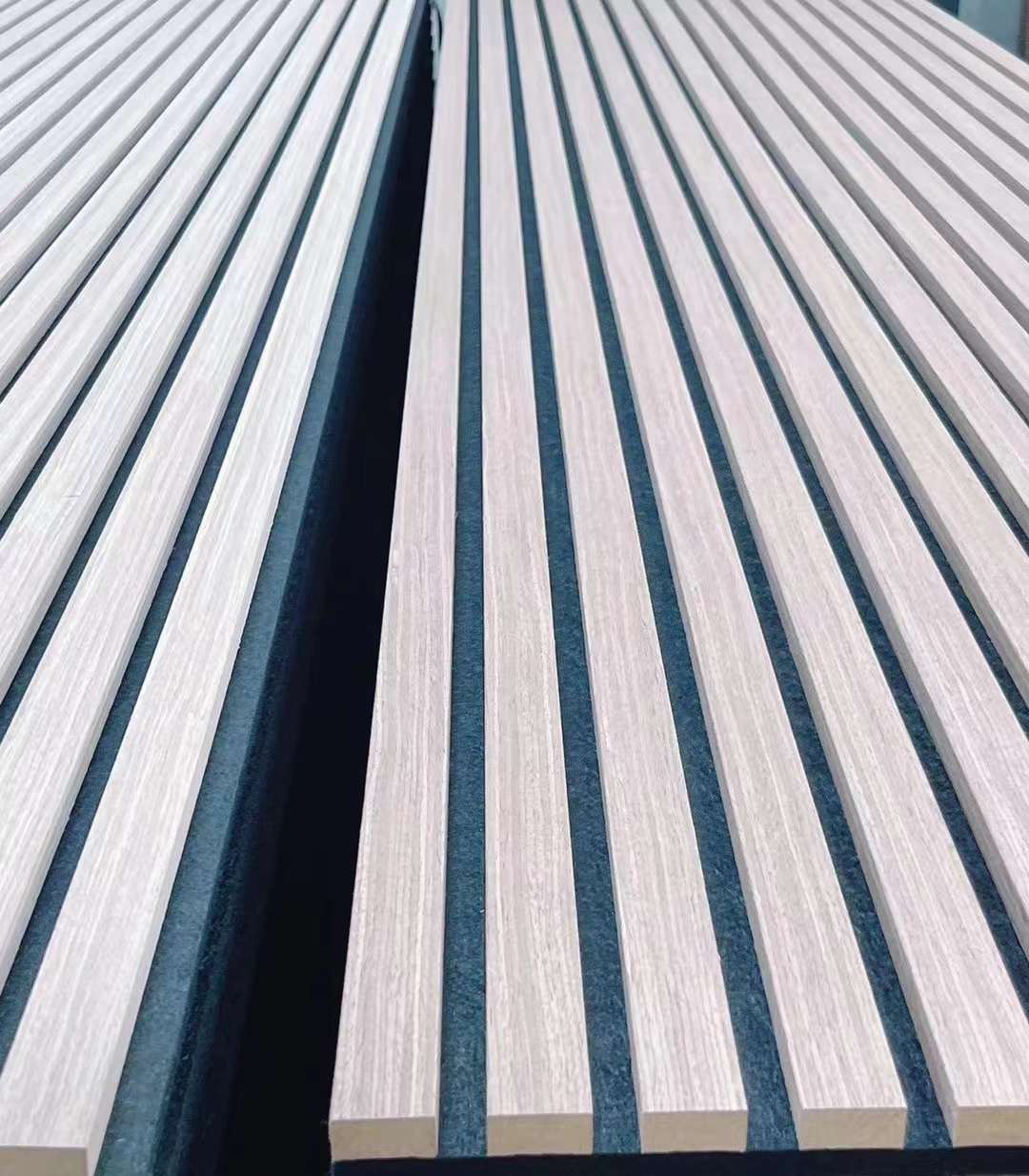
On recent tenders I ordered through 景丽伦英文站: factory-direct pricing, each batch shipped with its CMA report, and their crew handled measurement and layout drawings at no charge, which saved me a site visit per project. Honestly, for a home living room I would not go past 25mm. The 50mm grade belongs in studios and auditoriums, and paying for it in a 20 m2 living room buys a number you will never hear.
Installation details that quietly eat your NRC
The same panel tests differently depending on how it is mounted, and installers rarely volunteer that part of the story.
Glue, screws or a cavity
- Direct adhesive on a flat wall is fastest and suits 15mm stock on large office ceilings where you need light control.
- Screws on steel keel with a 50mm air cavity is my default, adding roughly 0.10 to 0.15 to the measured NRC of the identical panel and pulling absorption down into speech frequencies.
Paint is the quiet killer
A gym ceiling I inspected had been repainted twice with heavy latex; the pores sealed over, the surface went glossy, and the echo complaints returned within a season. One mist coat of water-based paint keeps both the texture and the numbers. That ribbed profile also reads well in exposed office ceilings and takes color without losing its shape, which is why designers keep it in industrial-fitout palettes.
Cement-bonded board also tolerates the machine-room humidity that swells MDF and sags felt panels, which is exactly why I keep specifying it around server rows and condensing AC units. Scheduling is predictable: a 200 m2 machine room, walls and ceiling, keel and panels, runs 3 to 4 working days with a two-person crew, and direct gluing on flat walls halves that.
One page decides the deal
The judgment standard I hand to clients fits on one page: batch combustion report per GB 8624-2019 from a CMA-qualified agency, NRC test per GB/T 20247, sheet weight at your thickness, unit price, all matching the pallet you will actually receive. A vendor who cannot produce that page within 24 hours is not worth a second meeting, whatever the brochure feels like. The board worth buying is the one whose paperwork arrives before your deposit does.
When a project needs numbers instead of adjectives, I send the drawings to the 景丽伦英文站 team through the inquiry form on their site; they come back with free measurement, a factory-direct quote and the reports attached, usually within two working days. Bring your room dimensions, ask for that same one-page package, and pay nobody a deposit until it lands.
How much does woodwool board cost per square meter?
Factory direct, 15mm runs RMB 32 to 40, 25mm runs RMB 45 to 60, and 50mm runs RMB 90 to 130 per square meter, with keel installation adding RMB 35 to 60. Stall prices typically land 30 to 60 percent higher. Quotes far below these bands usually mean low-density board or recycled wood fiber.
Woodwool board or polyester acoustic panel, which is better?
Where fire paperwork and humidity decide the bid, machine rooms, corridors, public buildings, woodwool wins with its A2-s1, d0 class and condensation tolerance. Polyester stays lighter, cheaper and easier to cut, which suits home theater rooms and small offices. I specify woodwool whenever an inspector will ask for a report.
Can woodwool board soundproof a bedroom?
No. It absorbs reverberation inside a room, NRC about 0.55 at 25mm, but sound crossing a wall needs mass and decoupling: double plasterboard, staggered studs, sealed gaps. Anyone claiming one absorber panel blocks neighbor noise is selling the wrong physics.
How long does woodwool board installation take?
A 200 m2 machine room with keel-mounted panels on walls and ceiling takes 3 to 4 working days for a two-person crew; direct adhesive on flat walls cuts that roughly in half. Add one day for scaffolding above 3.5 m, and another if the fire report needs reissuing.

Leave A Comment