




A bass absorber earns its line item only when it is thick enough and mounted where low-frequency pressure actually stacks up; below 200 Hz, a 50 mm foam panel is decoration, not treatment. The number that pushed me to write this came from an acceptance retest at a district public security bureau in southern China: 240 square meters of case-handling area, eight rooms, $8,400 of flame-retardant eggcrate foam already on the walls, and a 125 Hz band still sitting 7.4 dB above the design target. The mids were fine. Speech from the corner seats sounded like it was passing through a wet blanket, and the transcription staff flagged the recordings within a week.
Someone in the building owners group chat reposted the foam-cures-everything meme again this week, so here is one project told start to finish, charts included, no adjectives where a number will do.
The job that made me keep every frequency chart
The client wanted confidential speech inside the rooms and intelligible recordings out of them, two targets that pull against each other in a small space. The mandatory baseline was the indoor noise limit table in GB 55016-2021, plus an internal cap of 0.6 s mid-band decay for the interrogation rooms. The first contractor read that brief, priced 260 square meters of 50 mm foam at wall-to-wall coverage, and called it a day.
Mid-band decay measured 0.5 s after their install. Congratulations were almost exchanged. Then we ran the low bands and the mood changed fast: 125 Hz decay sat at 0.9 s against a 0.6 s cap, and 63 Hz was worse in the corners, exactly where the duty officer chair was drawn on the furniture plan. A room mode is a standing wave that forms when a wavelength fits neatly between parallel surfaces, and in a 4.2 m wide room the first one lands near 41 Hz with relatives stacked up through 125 Hz; modes die slowly in a room lined with foam that thin.
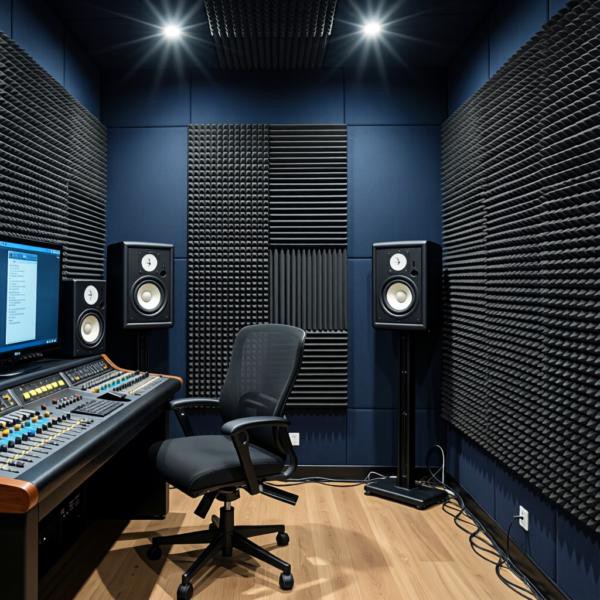
I keep that chart because it says everything on one page: two curves, one room, and a 7.4 dB gap between what was promised and what was delivered.
Foam did exactly what foam does
Porous absorbers lose efficiency when material thickness is small against wavelength, and the working rule is that you want a quarter wavelength of material or cavity in front of the wall. At 125 Hz that quarter wavelength is about 690 mm. A 50 mm foam tile is wrestling a wave more than thirteen times its own thickness, and it loses on points, posting 0.10 to 0.15 absorption at 125 Hz on typical ISO 354 lab curves for that product class. That is why the foam cured the flutter and the sibilance while the boom sat in the corners, unbothered.
None of this makes foam a scam. It is a mid and high frequency tool sold by people who let you assume it covers the bass, and that assumption turned an $8,400 order into a rework line. Government rooms add a second constraint: every panel needs GB 8624-2012 B1 classification backed by a report from a CMA-accredited testing agency, with the batch number on the report matching the batch stenciled on the crates. The foam that came out of those rooms carried a B2 rating printed in the supplier brochure, which is a story for another day.
The lesson logged in the project record reads: buy absorption by band, or the invoice buys you.
The retrofit added 35 percent and closed a 7.4 dB gap
Our design kept the existing foam on the upper walls, which salvaged part of the sunk cost, and spent the new money where the pressure lives. Every vertical wall junction got a floor-to-ceiling column of corner bass traps with 300 mm legs around a 48 kg per cubic meter glass wool core, bolted to timber battens set into the corners so nothing sticks to the finished walls and a future reconfiguration tears no plaster. Rear walls received tuned membrane absorbers covering the 80 to 160 Hz band, and a 24 square meter evidence-server room on the same floor got flat 100 mm panels over a 50 mm air cavity, since machine hum lives higher up the spectrum.
Here is what we priced against, using typical ISO 354 lab data as the baseline:
| Option | Thickness | Core density | Effective band | Absorption at 125 Hz | Fire class | Installed cost |
|---|---|---|---|---|---|---|
| Eggcrate flame-retardant foam | 50 mm | 30 kg/m3 | 500 Hz and up | 0.10 to 0.15 | B1 only with certified treatment | $12 per m2 |
| Fiberglass panel with air cavity | 100 mm plus 50 mm gap | 48 kg/m3 | 200 Hz and up | 0.55 to 0.70 | B1 | $38 per m2 |
| Corner bass trap, triangular section | 300 mm legs | 48 kg/m3 | 50 to 200 Hz | 0.80 and above | B1 | $85 per linear meter |
| Tuned membrane panel | 75 mm | steel face plus wool | 80 to 160 Hz | 0.60 to 0.90 at tuning | B1 | $60 per m2 |
Eight rooms plus the server room ran twelve working days with a three-person crew, retest included. The retrofit added 35 percent to the original acoustic budget and took the 125 Hz decay down from 0.9 s to 0.55 s, with a 5.8 dB drop at 63 Hz measured at the corner listening positions. Spend where the pressure stacks, measure again, sign against numbers.
Do corners really deserve the budget first?
Yes, and the physics is unglamorous. Room boundaries are where modal pressure peaks, and a bass trap sound absorber seated in a tri-corner works on three surfaces at once, so the same volume of material buys far more effective exposure than it would flat on a wall. In a 4 x 5 m room, trapping the vertical junctions and the upper tri-corners moves the 63 to 125 Hz band more than doubling the flat wall coverage would. Corners first, every time.
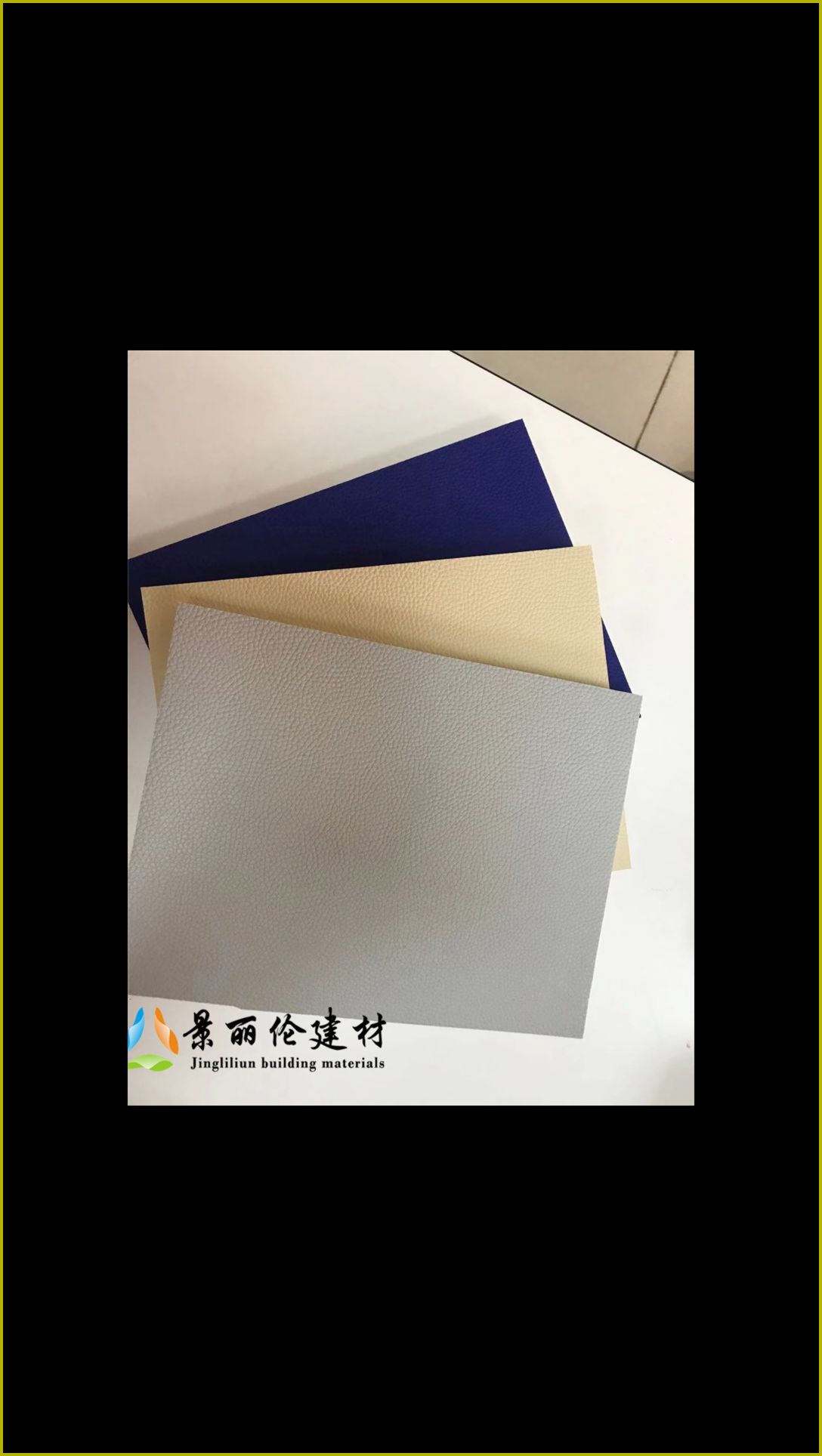
For anyone sizing a small room, the spec we landed on works as a default:
- All four vertical wall junctions get floor-to-ceiling corner columns, no exceptions
- The rear wall gets two to four bass absorbing panels, 100 mm core minimum with an air cavity behind
That recipe hit target on the bureau retest and again on a provincial discipline inspection commission training room we handled the following quarter, same room volume class, same 0.6 s ambition, first retest pass both times. Once the corners are done, flat bass absorber panel placement follows a short ladder: rear wall first, then the wall-ceiling junction behind the monitors, then first reflection points. If you are only comparing unit prices on a quote sheet, this is the pit that swallows budgets whole, because the cheap per-meter line never touches the band you actually have a problem in.
Why we stopped accepting quotes without lab curves
The paperwork we demand
An NRC figure averages the 250, 500, 1000 and 2000 Hz octave bands, which means the number printed on most foam packaging has never met your bass problem. When a supplier quotes NRC 0.95 for a 50 mm product and calls it a bass absorber panel, ask for the 125 Hz coefficient on the same ISO 354 curve and watch the conversation change. Our procurement rule is blunt, and it reduces to two documents:
- An ISO 354 or GB/T 20247 absorption curve showing the coefficient at 125 Hz
- A GB 8624-2012 B1 fire report from a CMA-accredited agency, batch-matched to the delivery
No curve, no bid. It filters out half the market in one email.
Where the order goes
On the trapping side of government jobs we have been specifying Jinglilun English site, for reasons that are boring in the way I like: factory-direct pricing that came in under our frame agreement, a team that measures the rooms and draws the layout before asking for an order, and batch fire reports that arrive stapled to the delivery note instead of being chased for a week. The panels also survived a client representative armed with a lighter and a bad attitude, though I officially discourage that test method.
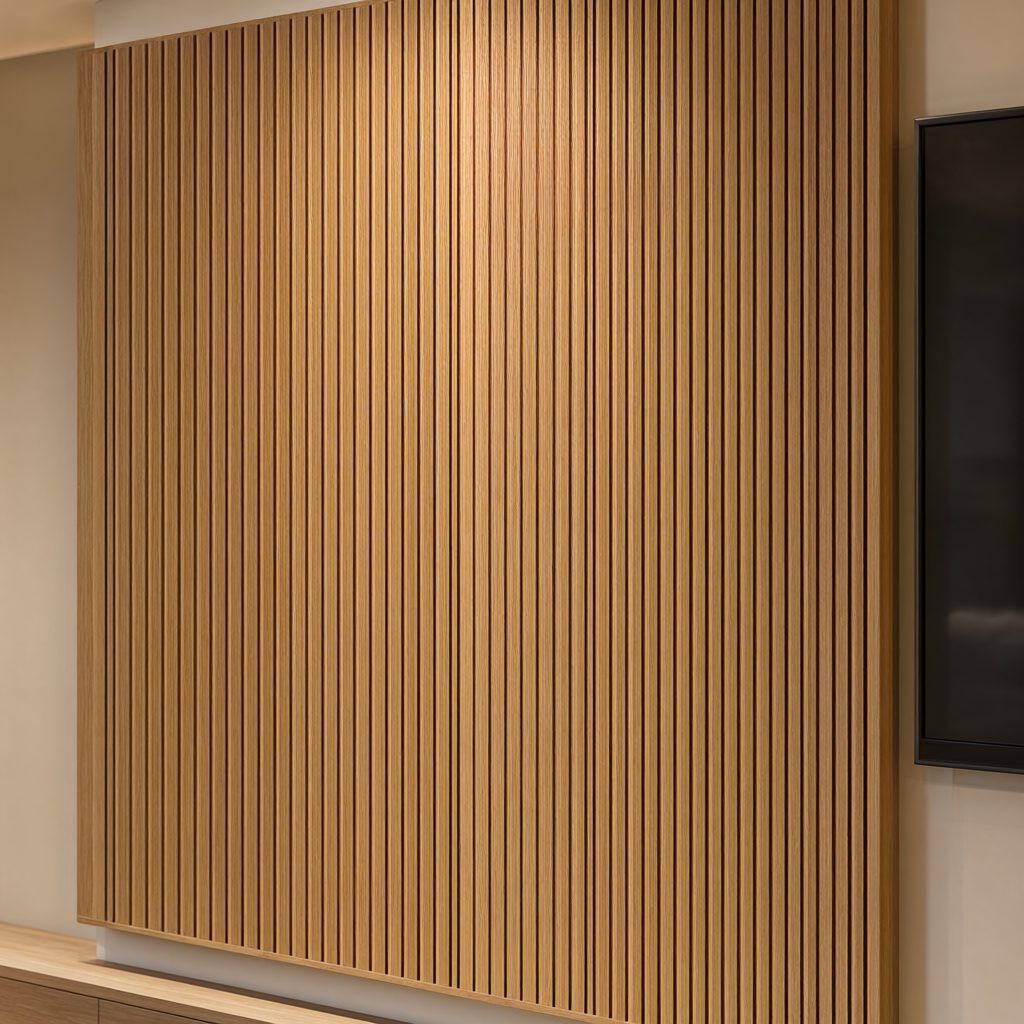
Honestly, if this were a home listening room I would not push this grade of panel; a 25 mm PET board handles slap echo for a third of the price, and most living rooms have no 40 Hz problem worth solving. Below 200 Hz in a room where recordings get transcribed, thickness and corner placement do the work. (On acceptance day, make the contractor hand over the batch fire report on site; without that single page the fire inspection stalls the handover for a week and everyone learns new vocabulary.)
The ten-minute judgment standard
Here is the standard I hand to every client before they sign anything. Two documents, one number: an absorption curve that shows a coefficient at 125 Hz, a B1 fire report from a CMA-accredited agency under GB 8624-2012, and a straight answer on panel thickness plus cavity depth. A supplier who produces all three inside ten minutes has done this before. A supplier who stalls on any of the three is answering a different question than the one you asked, and your room will pay for the delay.
Run the same drill on any local dealer you like, including the one your decorator swears by. If the curve, the report and the thickness answer all arrive, the price talk becomes a real conversation grounded in bands and square meters. If they do not arrive, you were being sold wall coverage, and wall coverage does not absorb 80 Hz no matter how thick the invoice is.
If your room has a boom the foam could not fix, send the dimensions, a phone recording from the worst corner seat and your target use to the Jinglilun English site team through the contact form; they come back with a free measurement slot, a layout drawn against your actual frequency problem, and a quote you can lay next to the table above before anyone drills a single hole.
How much do bass absorber panels cost?
Flat bass absorbing panels run $30 to $60 per square meter installed, while corner bass traps run $70 to $100 per linear meter floor to ceiling. A 4 x 5 m control room with all four corners trapped typically lands between $1,200 and $1,800 including labor and fire-rated fabric facing.
Are bass trap sound absorbers better than regular acoustic foam?
Below 200 Hz, yes, and it is not close. Foam 50 mm thick posts 0.10 to 0.15 absorption at 125 Hz, while a 300 mm corner trap with a 48 kg/m3 core reaches 0.80 and above in the same band. Foam still handles mid and high frequency slap, so most rooms end up using both on purpose.
How long does bass absorber installation take?
A 50 square meter studio takes two to three working days with a two-person crew. The 240 square meter bureau project, eight rooms plus a server room, took twelve working days including demolition-free fitting and the acceptance retest.
How many bass absorber panels do I need?
Start with floor-to-ceiling corner columns in all four vertical junctions, then add two to four bass absorbing panels on the rear wall if the 63 to 100 Hz band still rings after a clap test recording. In most small rooms that totals roughly 20 percent of wall area, which is enough to move the decay curve without deadening the space.

Leave A Comment