




Last month I signed the acceptance sheet on an interrogation-room retrofit for a municipal public security bureau in East China: 186 square meters of fabric-wrapped panels on the walls, reverberation time at 500 Hz down from 1.4 s to 0.6 s, one inspection pass, zero rework. Two years earlier, a client two streets away accepted a quote roughly 30% lower for a similar room. His panels started sagging off the drywall in month five, and the re-glue cost more than his original discount had saved.
So here is the version I give anyone comparing sound panels for walls right now: judge a panel by its NRC rating, its fire certificate and its fixing method, in that order, and let price speak last. A panel without a GB 8624 B1 burn report fails acceptance on day one no matter how clean the quote looks, and an NRC 0.90 panel glued onto a dusty wall will be on the floor by summer. Everything below is the comparison I wish clients read before signing.
One acceptance sheet, two endings
NRC is the average absorption coefficient a laboratory measures at 250, 500, 1,000 and 2,000 Hz under ASTM C423, and it is the first number I write on any quotation. Zero means the surface reflects sound like glazed tile, 1.00 means it swallows nearly everything, and most commercial products land between 0.40 and 0.95. Thin 9 mm polyester board sits near 0.45; a 25 mm fabric-wrapped fiberglass panel reaches 0.85 to 0.90 in the lab reports I have handled.
The interrogation rooms above needed speech clarity, because officers record interviews there and playback has to hold up in court. We covered about 45% of the wall area with 25 mm panels and measured 0.6 s at 500 Hz on the handover test, down from 1.4 s in the bare room. A podcast studio client in south China, 22 square meters with panels on the front wall and corner traps, landed at 0.35 s, which is the range voice engineers ask for.
Absorption is not soundproofing
Listings that promise sound proof panels for walls to shut out the neighbors are promising the wrong physics. Absorption panels tame echoes inside a room; they do not stop sound passing through a wall. Blocking noise takes mass and decoupling: a retrofit with a second layer of 12 mm gypsum board on resilient channels plus 50 mm mineral wool in the cavity typically gains 5 to 8 dB in laboratory tests, while a 25 mm decorative panel gains close to nothing against the neighbor's television.
If the problem is street noise or a snoring partner, plan the wall build first and treat panels as the finishing layer. If the problem is echo, flutter between parallel walls, or a home office where every call sounds like a bathroom, panels are exactly the right tool. Mixing the two up is the expensive confusion in this category, because people double the panel coverage expecting quiet and get a better-sounding version of the same noise.
What do the main materials cost, and what does each one buy?
Prices below come from 2024 supplier quotations collected for two tenders, factory gate, before shipping and installation. Suppliers relabel the same board as sound panels for walls, acoustic panels, or sound boards for walls, so compare spec sheets rather than names. NRC figures are laboratory values at the stated thickness, and production batches drift a little, so ask for the test report that matches the goods on the truck.
| Material | Thickness | NRC | Fire class | Factory price (USD/m2) | Where it wins |
|---|---|---|---|---|---|
| Polyester fiber (PET) panel | 9 / 12 mm | 0.40 / 0.55 | GB 8624 B1(b) | 4 to 7 | Budget offices, large ceilings, fast glue-up jobs |
| Fabric-wrapped fiberglass panel | 25 mm | 0.85 to 0.90 | GB 8624 B1, ASTM E84 Class A | 14 to 25 | Studios, meeting rooms, interrogation and clinic rooms |
| Slotted acoustic wood panel (MDF with PET backing) | 16 + 15 mm | 0.70 to 0.80 | B1 with fire-retardant MDF, otherwise B2 | 16 to 30 | Lobbies and feature walls where looks carry weight |
| Wood wool cement panel | 20 mm | 0.60 | GB 8624 B1 | 10 to 18 | Gyms, workshops, humid rooms, factory floors |
| Perforated aluminum panel with mineral wool | 20 mm assembly | 0.75 | Class A / A2-s1,d0 | 28 to 45 | Exterior acoustical wall panels, plant rooms, roadside barriers |
Read the table the hard way: never compare NRC across different thicknesses, because 12 mm of anything cannot match 25 mm of the same product line. If you are holding two quotes right now, force each bidder to state NRC at a specific thickness, an installed price per square meter, and the adhesive brand; anyone who cannot fill in those blanks is selling you a color, not a panel.
Where acoustic wood panels for walls earn their price
Slotted panels, marketed as acoustic wood panels for walls or acoustic wooden panels for walls, work by Helmholtz resonance: sound slips into the slots, loses energy in the cavity behind, and the black PET felt backing catches what survives. That mechanism leans toward mid and high frequencies, roughly 500 to 4,000 Hz, which is the band of human speech, so these panels suit lobbies, offices and restaurants where conversation clarity matters. The backing decides everything: a slot pattern over 3 mm decorative felt does almost nothing, while the same 16 mm slotted face over 15 mm of PET felt reports around 0.75 in the certificates I have reviewed.
Honestly, for a home bedroom I rarely recommend a full-height slotted wood wall, because you pay extra for the grain and bedrooms seldom need wall-to-wall coverage. Half of one wall, or a wood headboard panel flanked by 12 mm PET, lands within a shade of the same acoustic result for a third of the cost. Wood pulls weight up above eye level too: sound panels for ceiling in a meeting room with glass on two sides, wood wool or slotted boards over the table, will do more for intelligibility than another row of wall panels.
The fire report you skip is the one the inspector requests
GB 8624-2012 is the Chinese classification for how building materials burn, B1 marks a flame-retardant material, and every commercial project I deliver specifies B1 on the drawing before any color discussion starts. Quality PET panels declare an oxygen index of at least 32%, and fabric-wrapped fiberglass for international clients should carry ASTM E84 Class A or EN 13501-1 B-s1,d0 alongside GB 8624 B1. On the chemical side, GB 18580 sets the E1 formaldehyde limit at 0.124 mg/m3, and cheap adhesive is where that number quietly dies.
(A site note that saved me once: ask the crew to bring the burn report for the delivered production batch, not the showroom sample book, because on the interrogation job the acceptance inspector matched report numbers against panel labels, and any mismatch would have stalled handover by a week.) Outdoors, exterior acoustical wall panels in perforated aluminum need a UV-stable powder coat and a drainage-backed assembly; a soaked mineral wool core loses absorption and grows things you do not want on a boundary wall.
How many sound panels does a bedroom actually need?
GB 55016-2021, the mandatory Chinese code for building environments, sets the nighttime noise limit for residential bedrooms at 37 dB(A), and that number concerns sound entering the room, which panels by themselves cannot fix. What sound panels for bedroom walls do fix is the room's own echo, and the required area is smaller than people assume: 25% to 35% of the reflective wall surface, concentrated at first-reflection points beside and slightly behind the listener, takes a bedroom from hollow to settled. A 15 square meter bedroom finished in 12 mm PET or mid-range fabric is a one-worker, one-day glue job.
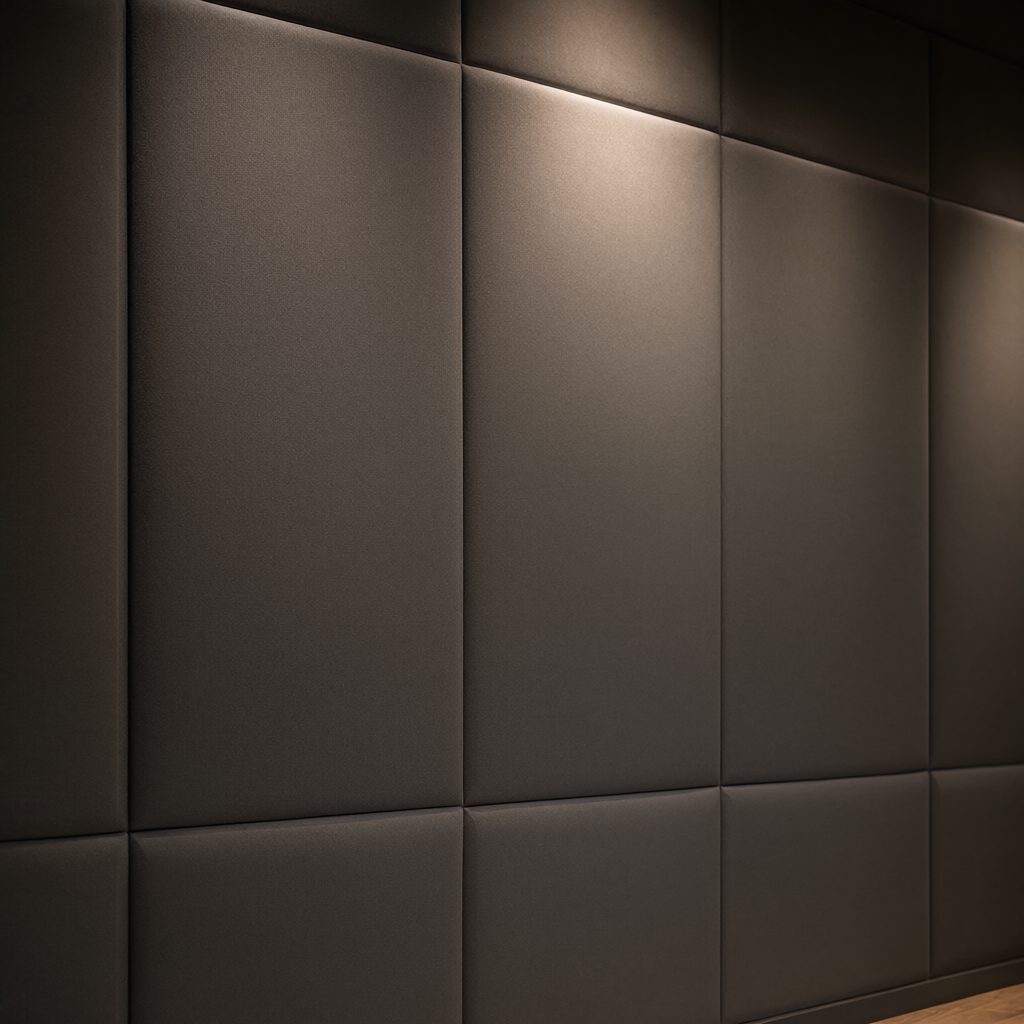
The pattern I keep seeing on renovation forums is people papering every wall, then complaining the room feels dead while the elevator still growls through the structure. Panels handle reflections. Structure-borne noise needs a floating floor or a decoupled wall, which is a different budget conversation entirely.
How does a delivered project actually run?
On the interrogation job, the winning panel came factory-direct from Jinglilun英文站 after a three-supplier comparison, and the reasons had little to do with the sample book. Their team completed the on-site measurement and the panel-by-panel layout drawing free of charge, quoted about 12% below the local distributor for the same 25 mm fabric-wrapped specification, and shipped every carton with the batch's CMA-accredited burn report and E1 adhesive certificate attached.
- Direct glue is the fastest and cheapest fixing, but the bond fails on dusty, unpainted or crumbling walls, and a glued panel is not coming off again without a fight.
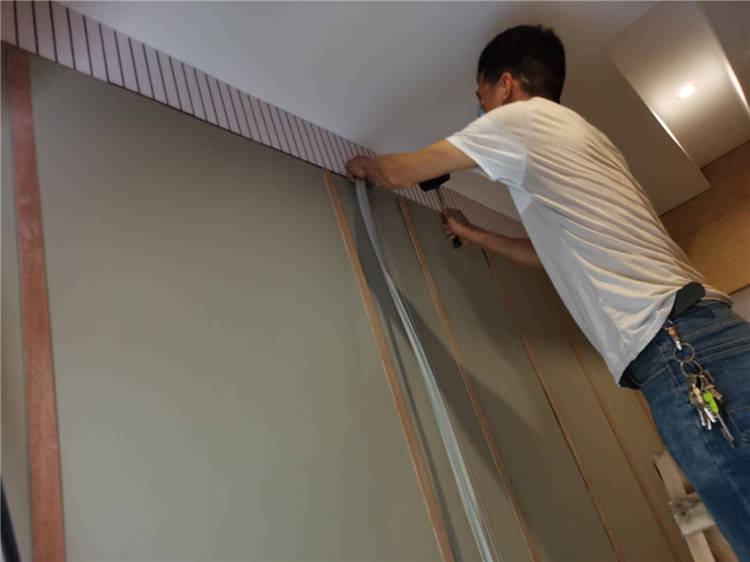
- Aluminum z-clips add about 5% in material cost, keep panels removable for future cabling work, and hold flat through humidity swings, which is why every interrogation room used them.
Timeline for the record: measurement on Tuesday, layout approval on Thursday, 186 square meters installed in four working days by a three-person crew, first-attempt pass at acceptance the following week. Factory-direct means fewer hands between the production line and your wall, and fewer hands between the panel and the paperwork proving what it is.
The check I run before signing anything
Make the supplier state the NRC at the exact thickness being purchased, attach a batch fire report from a CMA-accredited laboratory, and quote an installed price per square meter including E1-rated adhesive. If any of those three lines comes back blank, the deposit stays in your account.
If you want the material list, layout drawings and fire reports from that handover, send your room dimensions to Jinglilun英文站 through the site contact page or WhatsApp, and the measurement team will return a panel-by-panel layout with a fixed quotation within 48 hours.
How much do sound panels for walls cost per square meter?
From 2024 factory quotes: 9 mm PET panels run 4 to 7 USD per square meter, 25 mm fabric-wrapped fiberglass 14 to 25, slotted acoustic wood 16 to 30, and perforated aluminum assemblies 28 to 45. Installation adds 3 to 6 USD/m2 for glue methods and 5 to 8 with z-clips or battens. Always demand the price per square meter installed, never per panel.
Will sound proof panels for walls block noise from neighbors?
No. These panels absorb echoes inside your own room; blocking transmission needs mass and decoupling, such as double 12 mm gypsum board on resilient channels with 50 mm mineral wool, typically gaining 5 to 8 dB. Buy absorption panels for echo and flutter, plan a wall build for the neighbor's television, and distrust any listing claiming one product does both jobs.
What fire certificate should wall sound panels come with?
For the Chinese market, GB 8624-2012 B1 is the working baseline on any commercial drawing; international clients should ask for ASTM E84 Class A or EN 13501-1 B-s1,d0. Insist on a burn report from a CMA-accredited laboratory matching the delivered batch, and check the oxygen index, which quality PET panels declare at 32% or higher.
How long does it take to install sound panels in one bedroom?
A 15 square meter bedroom takes one worker one day with 12 mm PET panels glued directly to the wall. Fabric-wrapped panels on z-clips need 1.5 to 2 days including layout marking. Add a day if the walls are uneven and need furring battens, and order panels cut to size so the crew is not trimming on site.
Are acoustic wood panels for walls better than fabric-wrapped panels?
Neither wins everywhere; slotted wood with 15 mm PET backing reports NRC around 0.75 and leads on appearance and mid-frequency speech clarity, while 25 mm fabric-wrapped fiberglass reaches 0.85 to 0.90 at a lower price. Choose wood when the room has to impress visitors, choose fabric when the measured number leads the decision, and skip any slotted panel with thin decorative backing.

Leave A Comment