




A quote for acoustic sound panels that omits the NRC value and the fire class report is a price attached to nothing, and I say that with a red pen already in my hand. The sheet on my desk sells panels at 18.60 USD per square meter, installed. The NRC column is blank. So is the fire class line. A fellow contractor sent it over for a sanity check ahead of a client meeting, and I had marks on it before page two.
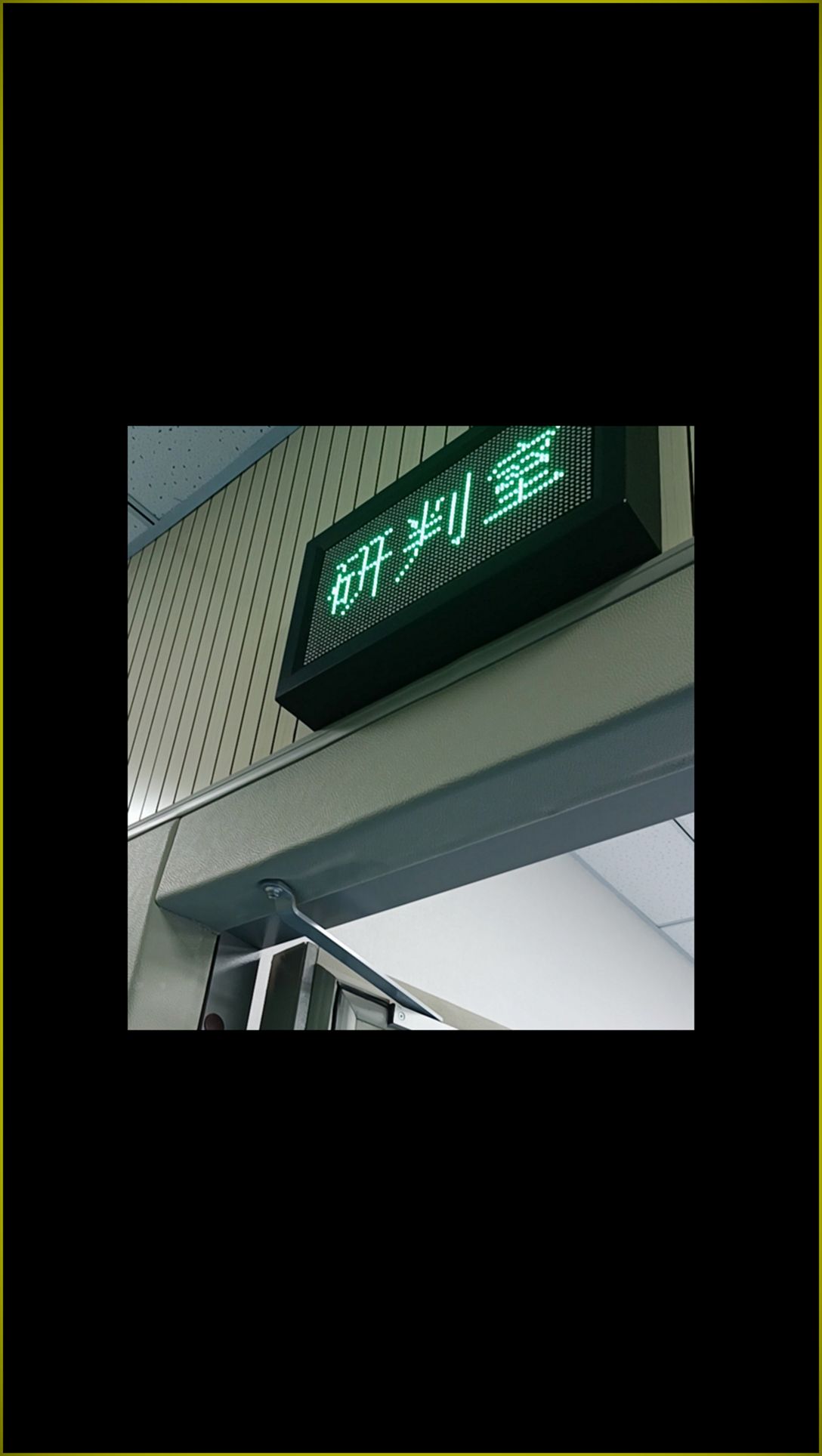
That sheet is a good excuse to retell the project that proved the point with real money on the line: a renovation at a municipal public security bureau in eastern China, 140 m² of case-handling floor, where four interrogation rooms, one recording room and a long corridor all had to behave before anyone signed anything.
A case room that failed its own recording
The call came through a mutual contact in early spring. Voice recordings from the interrogation rooms came back muddy enough that transcription took twice the usual time, and a lawyer waiting outside had remarked he could follow the conversation in the next room through the partition. Both complaints checked out. Mid-frequency reverberation in the 14 m² rooms measured 2.6 s, roughly three times a workable level for clear speech, and airborne sound insulation between adjacent rooms came in at 36 dB, which is curtain-and-hollow-door territory, far below anything a case room should accept.
The tender brief the bureau circulated was thin. It asked for acoustics sound panels as a line item and stopped there, no model, no density, no coverage area. Three quotes arrived within a week. The one now on my desk beat the others on price by a wide margin, and it stayed cheap precisely because it committed to nothing measurable, which let the contractor deliver whatever the warehouse happened to hold that week.
I watched this product category climb out of the egg-carton era into engineered assemblies, and the constant across that whole stretch is that failures are rarely installation failures. They are procurement failures. A panel ordered as a description instead of a data set will disappoint a room every time, and no amount of careful screw work on site fixes it.
Absorption and isolation are two different purchases
The bureau director's brief, in his own words, asked for sounds absorbing panels on every bare wall he could see. That sentence needed unpacking before any order went out, because absorption and isolation are two different purchases built on two different kinds of physics, and confusing them burns more budget than any other mistake I meet on site.
Acoustic sound panels absorb reflected energy inside a room. They shorten reverb and sharpen speech, and they do almost nothing to stop sound crossing a partition. Acoustic isolation panels are the other animal: layered barrier assemblies with a mass-loaded core and damping skins, rated by the decibels they cut through a wall instead of the reverb they remove from a room. The 36 dB reading between rooms was a partition problem, so it demanded added gypsum, resilient clips, full-perimeter sealant and new gasketed doors. GB 55016-2021 sets mandatory minimums for airborne sound insulation between occupied rooms, and no surface treatment rescues an assembly that already sits below the line.
We split the budget along that physics. About 40 percent went into partitions and doors, 60 percent into absorption, and I would repeat that ratio on any case-handling floor with cross-talk complaints. The standard shortcut on leaner quotes skips the wall work and doubles the panel coverage, and it produces rooms that sound clearer while still leaking every word to the neighbor.
What does NRC actually buy in a 14 m² room?
NRC is the single-number rating of how much sound a surface absorbs, averaged across the 250 Hz to 2 kHz bands under ASTM C423. For speech-heavy rooms under 20 m² I hold the line at NRC 0.75 or better, with 30 to 40 percent of the total surface area treated. Under that coverage the room keeps a metallic tail on consonants regardless of how good the individual panel happens to be.
Coverage math for a 14 m² room
Each interrogation room received 11 m² of 50 mm fabric-wrapped panels on two adjacent walls, paired deliberately so the early reflections off the speaker's main axis die first. The Sabine calculation predicted a fall from 2.6 s to roughly 0.7 s at mid frequencies. The acceptance measurement later read 0.7 s flat across the 500 Hz to 1 kHz band, the exact range where speech intelligibility lives or dies.
Procurement people tend to miss one thing here. A quoted NRC assumes a defined mounting condition, and a panel glued flat to concrete delivers less than the same panel over a 50 mm cavity, because the trapped air layer works as part of the absorber. Two suppliers can quote identical NRC figures and hand you audibly different rooms purely through mounting method, which is why the installation spec belongs on the purchase order and not in a hallway conversation.
Fire class is where cheap quotes die
Government buildings do not haggle over combustion performance. The bureau's fire review accepted nothing below B1 under GB 8624-2012 for wall and ceiling finishes, and the recording room ceiling was pushed to A2 because of its dense electrical load. Every batch delivered to site carried a combustion report from a CMA-accredited laboratory, matched to the batch number on the crates, since a generic factory brochure satisfies nobody at a real inspection.
This is exactly where the 18.60 USD quote fell apart. Its product pages showed colorful renderings and the phrase eco-friendly twice, yet stated no GB 8624 class and no oxygen index anywhere. For the fabric-wrapped panels we specified, the accepted material carried an oxygen index of 32 percent or higher, a figure the bureau's reviewer checked line by line against the lab document before letting the batch off the truck.
There is also a paperwork trap on jobs like this that costs weeks rather than money. (Have the contractor bring the batch-matched combustion reports to the acceptance walk, because without that sheet the fire inspection stalls, and finished rooms sit locked and unusable while everyone points fingers.)
Material choice on one page
Three material families covered everything this floor needed, and the selection logic repeats anywhere. Fabric-wrapped fiberglass where speech clarity decides the room, PET felt where budget and humidity tolerance lead, wood slat systems where the client wants a face that reads as architecture instead of treatment. One shortlisted supplier pitched their acoustipanel modular clip-in line for the entire floor, which would have simplified logistics and completely missed the point, since a corridor and an interrogation room do not share a problem.
| Material | Typical NRC | Density / weight | Fire class, GB 8624-2012 | Installed cost | Where we used it |
|---|---|---|---|---|---|
| Fabric-wrapped fiberglass, 50 mm | 0.90-0.95 | 60-80 kg/m³ core | B1 | 24-32 USD/m² | Interrogation room walls |
| PET felt panel, 9 mm over 50 mm cavity | 0.55-0.70 | 1500-2000 g/m² | B1 | 14-19 USD/m² | Corridor ceiling |
| Wood slat panel, acoustic wood panel wall build-up | 0.60-0.70 | 8-10 kg/m² | B1, A2 option | 30-45 USD/m² | Corridor walls, recording room |
Those are installed figures from this project, subframe and labor included, sourced factory-direct through 景丽伦英文站. Their technical team ran the site measurement and the reverberation estimates free of charge, produced the layout drawings the acceptance review later referenced, and shipped every batch with the CMA-lab fire documentation attached. Buying direct cut roughly 15 percent against the local distributor quote for identical specifications, and the paperwork arriving complete saved the schedule more than the money saved.
A position I will defend: for a home office or an ordinary bedroom I would not push anyone into this grade of spec, because 9 mm PET on two walls fixes most domestic echo complaints for a third of the money. Reserve the thick fiberglass and the sealed partitions for rooms where a transcript, a negotiation or a verdict rides on every syllable.
Nine days on site
Installation ran nine working days, and the sequence matters more than the speed. All sound paneling went up after the HVAC ducting and electrical penetrations were sealed, because a panel mounted over an unsealed socket box absorbs nothing the box later leaks. The interrogation rooms used a clip-track system, which keeps every panel repositionable if room use changes after a reorganization.
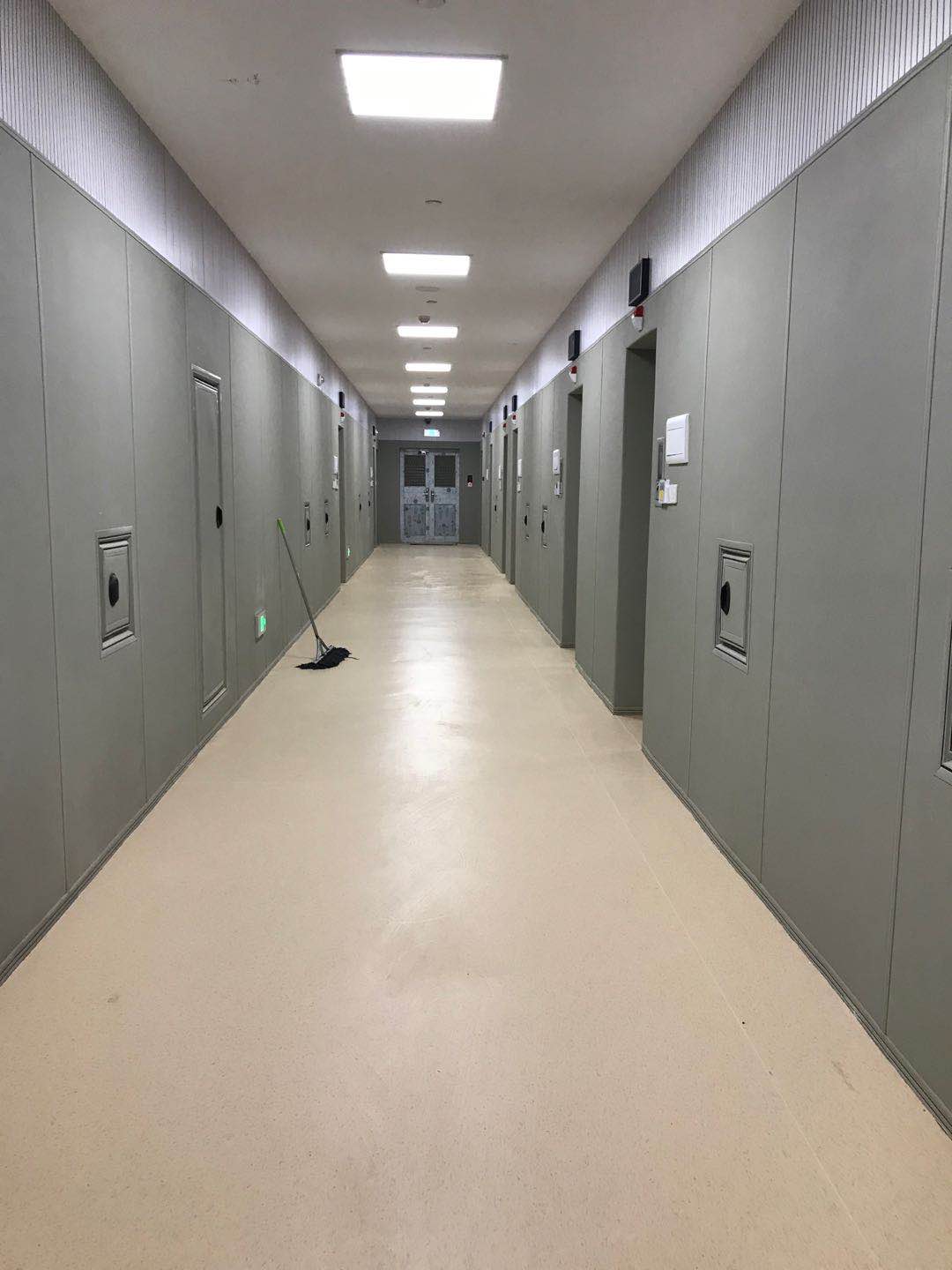
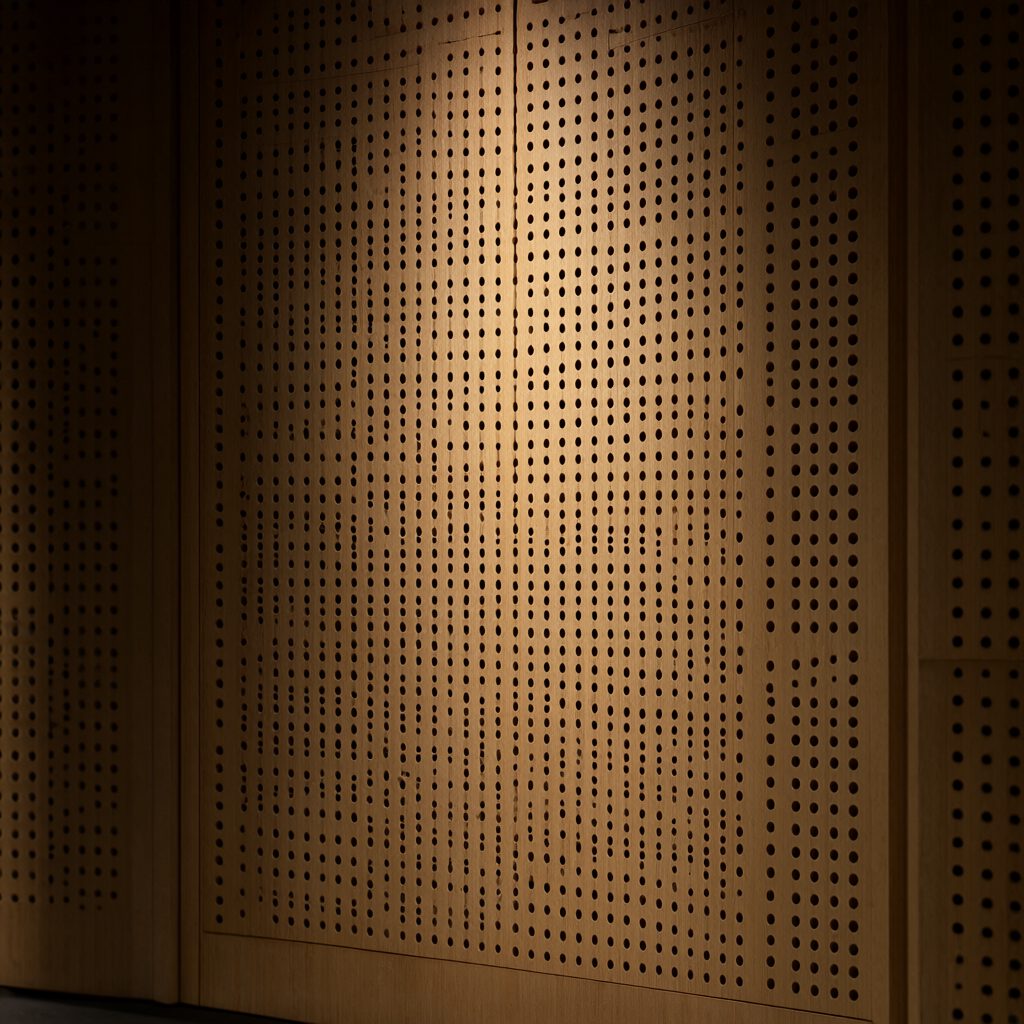
The 50 mm vented air gap behind the fabric panels went onto the purchase order as a hard requirement. A vented cavity behind an absorptive panel typically adds several absorption points at 250 Hz compared with full glue contact, and male speech energy pools exactly in that band, which is why the interrogations had been turning muddy before a word reached the recorder. The corridor took the acoustic wood panel wall build-up on plywood battens, oak slats facing out over black PET, so the long hard surface stopped slapping footsteps down its full length.
If you compare panel quotes and never ask how the panels mount, the mounting quietly decides your result while the invoice stays silent about it. That trap sits behind a shameful share of the disappointing rooms I get called to inspect.
The two lines that belong on every purchase order
- Cavity depth: 50 mm vented air gap behind all absorptive panels
- Fixing method: clip track with mechanical fixings, no full-face adhesive
The numbers on the acceptance sheet
Final measurements ran across two days with the bureau's supervising engineer present, microphone on a tripod at 1.2 m height and the HVAC running at normal duty. Interrogation rooms read 0.7 s mid-frequency reverb against the 2.6 s baseline. The recording room background level came in at 31 dBA with all plant running. Adjacent-room airborne insulation hit 49 dB, up from 36, and I will be blunt about where that gain came from: the partition rebuild and the gasketed doors, not the panels, because panels absorb and walls block, and any contractor crediting the panels for that number is selling the wrong story.
The acceptance sheet closed the argument with those figures, and the final invoice landed 12 percent under the middle quote purely because the spec was tight enough to compare like with like. The bureau filed the combustion reports, the NRC certificates and the layout drawings in a single folder, and that folder has since become the template I hand to new clients before a single panel ships.
Next time a quote lands on your desk, run one check before anything else. No NRC value and no GB 8624 fire class on paper, walk away whatever the price says; both present with a CMA-accredited lab report matched to the batch, then sit down and talk numbers. Send your floor plan and room photos through the contact page of 景丽伦英文站, and the free measurement, written reverberation estimate and layout drawing will come back to you, usually within two working days.
How much do acoustic sound panels cost per square meter, installed?
Installed prices from recent projects: PET felt runs 14-19 USD/m², fabric-wrapped fiberglass 24-32 USD/m², wood slat systems 30-45 USD/m². A quote far below those bands with no NRC value and no GB 8624 fire class on paper is usually a material substitution waiting to happen, so treat the missing data as the real price difference.
Do acoustic panels block sound between rooms, or only reduce echo?
They only reduce echo. Panels absorb reflected energy inside a room and shorten reverberation, and they barely slow sound traveling through a partition. Blocking sound between rooms takes mass, sealed cavities and gasketed doors, the territory of acoustic isolation panels and wall assemblies. If cross-talk is the complaint, fix the wall first and treat the room second.
What NRC rating should I demand for a meeting room?
Hold the line at NRC 0.75 minimum for speech-heavy rooms, with 30 to 40 percent of the total surface area treated. In rooms under 20 m², 50 mm fabric-wrapped fiberglass on two adjacent walls typically lands mid-frequency reverb between 0.6 and 0.8 s, which is the intelligible-speech zone verified on multiple acceptance measurements.
What fire rating do acoustic panels need in public buildings?
In China, wall and ceiling finishes in public buildings need B1 under GB 8624-2012 at minimum, and reviewers increasingly demand A2 above dense electrical loads. Require a combustion report from a CMA-accredited laboratory matched to the delivered batch number. A factory brochure with no class stated stalls at inspection every time.
How long does panel installation take for a 100 m² office?
Two to four working days with a clip-track system at around 35 percent wall coverage, plus one or two more days if ceiling baffles are included. Sealing electrical boxes and HVAC penetrations comes first and can add a day, but skipping it leaks sound around the panels no matter how good the panels are.
Fabric, PET felt or wood slat panels, which should I choose?
Match the material to the room's job, not the sample's looks. Fabric-wrapped fiberglass belongs in any room where speech must survive recording or negotiation, PET felt fits tight budgets and humid spaces, and wood slat suits corridors and lobbies that need a finished architectural face with NRC 0.60-0.70 behind it.

Leave A Comment