




Akupanel wood slat panels took one municipal bureau interview room from a measured 2.4 s reverberation time down to 0.6 s, in four working days, for about US$1,950 all in. The same panels did nothing against the 100 Hz transformer hum one floor below, and knowing which of those two jobs is yours decides whether you should buy them.
I walked out of a government service hall an hour ago with my ears still ringing: marble floor, glass rails, a ceiling that threw every announcement back at me twice. Noise complaints are my trade, transformer stations, elevator machine rooms, interview rooms where recordings turn to mush, so a bad room follows me home. The bureau project below is the cleanest story I have for what akupanels actually do, with numbers you can check against your own rooms.
A Bureau Interview Room That Failed Its Own Recordings
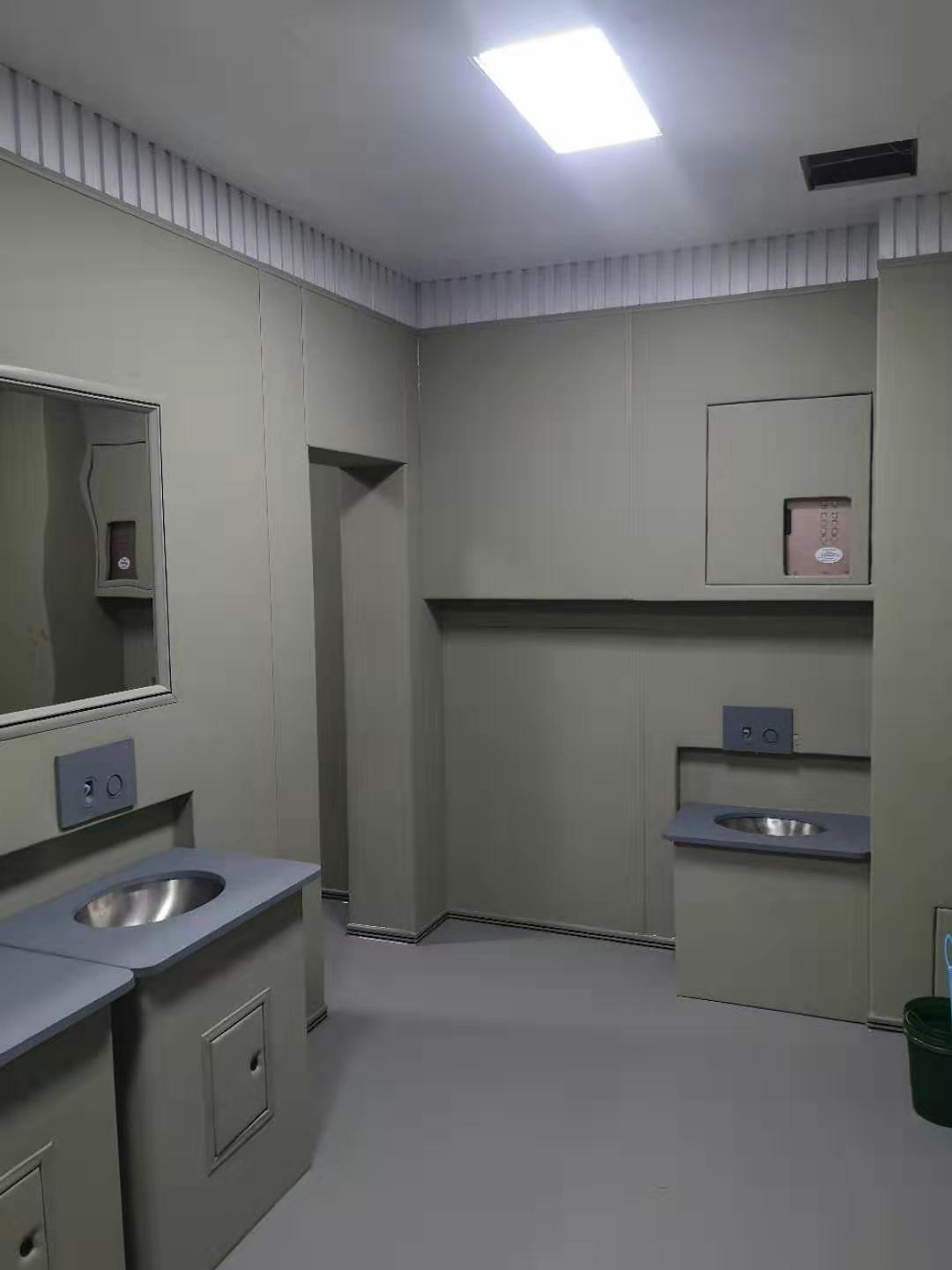
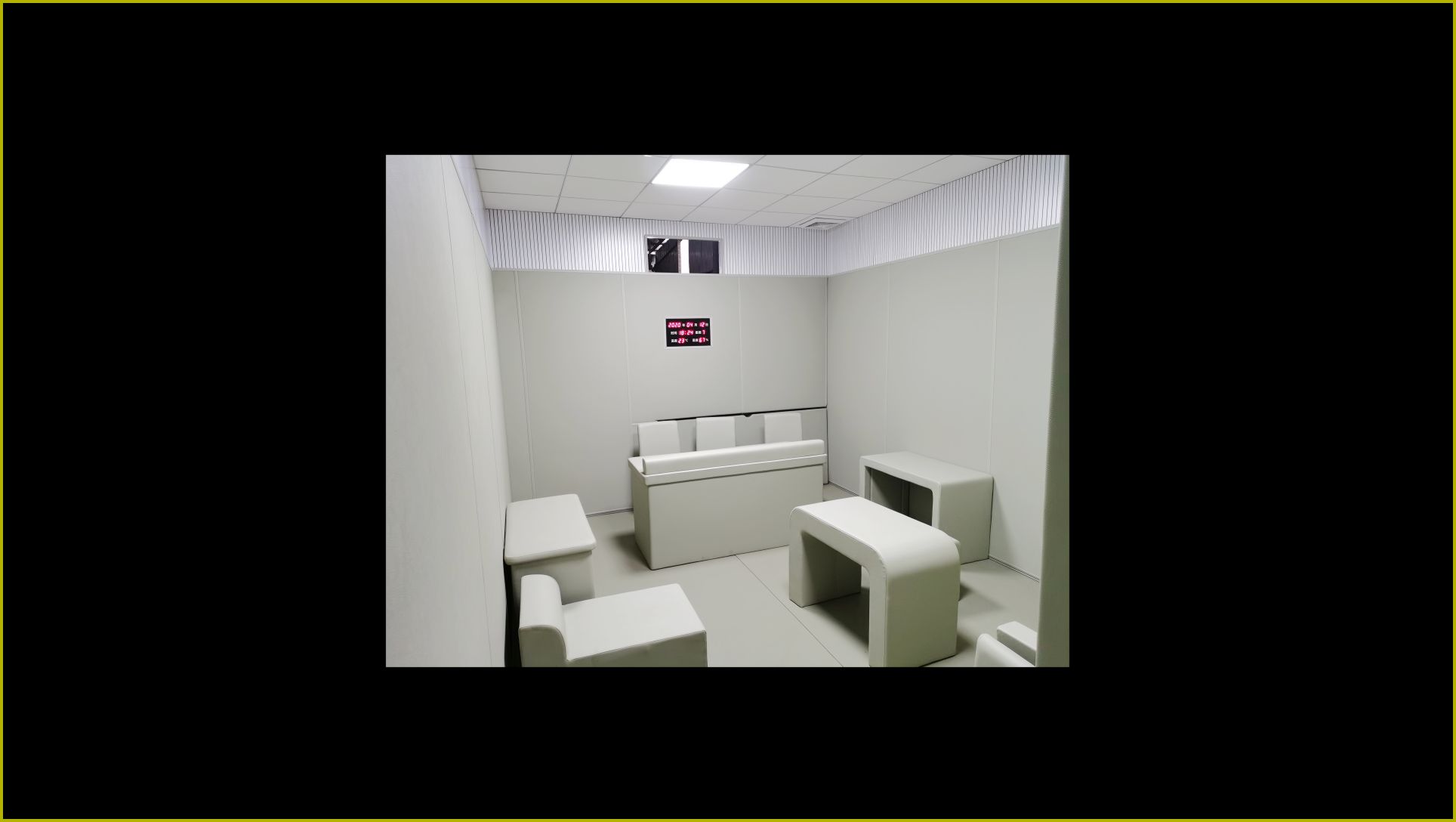
The client was the case-handling wing of a municipal public security bureau in central China: one 32 m² interview room, 2.7 m ceiling, a full-height glass wall on one side and painted concrete everywhere else. The transcribers had given up on the room. Their words in the complaint folder: the tapes "sounded like they were recorded in a stairwell". Every statement session meant replaying clips four or five times.
We measured before proposing anything, because ears lie and meters do not. Mid-frequency reverberation time, the average of 500 Hz and 1 kHz, came back at 2.4 s. Run the Sabine equation on that room, 86 m³ of volume, and the surfaces held roughly 5.8 m² of total absorption, while a 0.6 s target at the same volume needs about 23 m². The problem was echo, and echo is a different disease from volume.
Institutional rooms narrow the material list fast. Fabric-wrapped absorbers fail the pick-and-peel test wherever the public sits, mineral wool baffles make an interview room look like a parking garage, and open-cell foam fails fire acceptance outright. Wood slats on PET felt survived the shortlist, and that is the whole story of why akupanel wood panels ended up on these walls.
Does an Akupanel Absorb Sound or Block It?
Akupanel is a wood-slat acoustic panel, veneered MDF strips roughly 27 mm wide with 13 mm gaps, factory-bonded to a PET fiber felt that does the actual absorbing, around 21 mm thick as a finished sheet. The CMA lab report on our batch read NRC 0.70 flush-mounted and 0.85 with a 50 mm air cavity behind. Those two numbers are the entire product, and the cavity number is the one quotes like to hide.
Absorption is an inside job. The felt converts speech-band energy, roughly 500 Hz to 4 kHz, into heat, which pulls reverberation down inside the room. Transmission loss is a mass job, and a 21 mm decorative sheet adds almost none of it. An akupanel makes the room you stand in sound finished; it does not lower the decibels arriving through the wall.
Low frequency is where I get blunt. Porous absorbers this thin barely register at 100 Hz, and transformer hum sits at 100 Hz with harmonics at 200 and 300. When a complaint file says transformer, I stop discussing slat panels in the same meeting and start discussing mass layers, spring mounts, and sealed enclosures.
Reading the Spec Sheet Like a Lab Report
We ordered exactly three products for three different surfaces, which is the honest way to use the catalog. Standard akupanel wood covered the 28 m² of wall, the stiffer akupanel tr build took the 12 m² ceiling span, and a felt-face planeo akupanel field went into the adjacent corridor where budget beat appearance. Same family, three different jobs.
| Variant | Face build | Total thickness | NRC (batch lab report) | Fire class, GB 8624-2012 | Indicative price |
|---|---|---|---|---|---|
| akupanel wood | 27 mm veneered MDF slats, 13 mm gaps | 21 mm | 0.70 flush, 0.85 with 50 mm cavity | B1 (s1, d0) | US$26-34 / m² |
| akupanel tr | Denser slats, stiffer backing for spans | 24 mm | 0.75 flush, 0.88 with 50 mm cavity | B1 (s1, d0) | US$32-40 / m² |
| planeo akupanel | Slat-free exposed PET felt face | 12 mm | 0.80 flush | B1 (s1, d0) | US$22-30 / m² |
Figures come from the batch report of a CMA-qualified testing agency and the project acceptance form; retail prices were collected in early 2025 from three storefronts.
The order went factory-direct through 景丽伦英文站, and buying that way changed the service as much as the price. Their team ran the site measurement and the Sabine calculation before quoting, returned layout drawings with panel counts and seam maps, and every batch shipped with the CMA lab report and the GB 8624 fire sheet attached. Comparison quotes we collected, including akupanel usa and akupanels ie storefront listings for the same 21 mm spec, ran US$45-70 per square meter before shipping; our landed panel cost was US$29.
If you compare offers on panel price alone, trims and battens will eat the difference, since end profiles, outside corners, and batten lines pushed our non-panel spend to about a third of the total invoice. Ask every supplier for the per-octave absorption table, not a single NRC figure. A supplier who can only quote one number has not read the report they are selling.
Four Working Days and Two Fixable Mistakes
Two installers, forty square meters, four working days including the ceiling. The sequence was boring on purpose: vertical timber battens at 400 mm centers, panels screwed through the felt into the battens, seams staggered like brickwork, outlets and switch boxes cut before the first sheet went up. Boring sequences finish on time, and the acceptance retest read 0.6 s mid-frequency.
An akupanel ceiling plays by different rules
Ceiling work is where adhesive-only installs should end. The akupanel tr sheets weigh roughly 5.5 kg per square meter, and over a table where people sit, glue is not a fixing, it is a decoration. We screwed every ceiling sheet through the felt into battens, then added two mechanical clips per sheet as redundancy, because a panel falling from 2.7 m is an incident report nobody wants to write.

Two mistakes, both fixable, both worth stealing. Our delivery mixed two production lots, and the slat width differed by about 1 mm, enough to show at one long seam; a straightedge check on the first three sheets now happens before any screw goes in. The switch locations also changed after the layout was drawn, so day three was spent notching sheets on site, with the chip-out that implies. Mark every penetration before the level line goes up, and the chip-out never happens.
The Fire Report Nobody Reads Until It Fails
Fire acceptance in an institutional building is a paper exercise before it is a flame test. The batch combustion report from a CMA-qualified testing agency came back B1 (s1, d0) under GB 8624-2012, and without that single sheet the bureau's acceptance process stalls regardless of how the panels look. No report, no handover.
Emissions got the same treatment. Formaldehyde from the MDF slats tested at E1 under GB 18580-2017, meaning 0.124 mg/m³ or less by climate-chamber method, and the indoor air sampling after 48 hours of airing came back inside limits. Cheap panel lines fail exactly here, in the glue line and the slat core, never on the showroom face.
(At final acceptance, make the contractor hand over the batch combustion report and the formaldehyde sheet as physical copies; inspectors ask for paper and a sales PDF does not count.) While you hold the sample, press the felt backing hard; it should spring back rather than hold the dent, and a dented felt is an under-cured one that will sag within two summers.
What About the Transformer Hum Next Door?
The bureau had a second complaint on file, a 100 Hz hum from the distribution transformer one floor below, reading 36 dB(A) in the corridor at night with a clear pure tone. GB 55016-2021 has turned indoor noise limits into mandatory code language, and pure tones get judged harshly, so the hum had to be handled, just never by these panels.
We treated the transformer with spring isolators under the feet and a vented mass enclosure, while the corridor got its planeo akupanel field for the speech echo. Afterwards the corridor measured quieter to the ear and on the meter, but the attribution matters: the enclosure moved the 100 Hz tone, the panels moved everything humans say. Reverberation treatment makes a room sound finished. Isolation makes it quiet. Two different invoices, and confusing them is how budgets die.
If your own complaint file says transformer or elevator machine room, spend the first money on isolation and mass, then dress the room. And honestly, for a home bedroom I would not spec full-wall akupanel at all; a fabric-wrapped absorber at half the cost does the same job where nobody tests the walls with furniture.
A Ten-Minute Test Before You Sign Any Order
Bring the sample and the paperwork to one table and run two checks, enough to separate a factory batch from a trading-company reorder:
- Ask for the per-octave absorption table and the batch combustion report by name; a real factory attaches both within one message, a reseller forwards a glossy PDF with one NRC number.
- Lay three sheets edge to edge on a flat floor and run a straightedge across the seams, then press the felt; slat alignment within 1 mm and a backing that springs back are the pass marks.
Budget arithmetic matters as much as the sample. Panels ran US$29 per square meter on this job, but the finished wall cost nearer US$49 once battens, trims, fasteners, and labor landed, so add 40 percent to any panel quote before comparing it to anything. Renters should ask about track-mounted or adhesive-backed options before drilling battens into a wall they do not own.
The standard I use on site: a supplier who answers the per-octave question in one message, with a sample whose seams line up on a flat table, is a supplier whose project turns into carpentry instead of acoustics. That sentence has settled more arguments than any meter I own.
How much do akupanel wood panels cost per square meter?
Factory-direct pricing on this project ran US$26-34 per square meter for standard akupanel wood, landed at US$29. Retail listings, including akupanel usa and akupanels ie storefronts, typically quoted US$45-70 for the same 21 mm spec. Add roughly 40 percent for battens, trims, fasteners, and labor.
Do akupanels block noise from neighbors?
No. Akupanels absorb reverberation inside a room, NRC 0.70-0.85 on our batch, but they add almost no transmission loss through a wall. Blocking airborne noise needs mass and decoupling: added drywall layers, resilient channels, sealed penetrations. Panels are the finishing step, not the barrier.
What is the NRC rating of akupanel wood panels?
The CMA lab report on our batch read NRC 0.70 flush-mounted and 0.85 with a 50 mm air cavity behind the panel. The cavity figure is the honest one for finished rooms, so any quote that hides the mounting condition is incomplete; ask again before paying.
Can you install akupanel on a ceiling safely?
Yes, with mechanical fixing. Ceiling sheets around 5.5 kg per square meter must be screwed into timber battens; adhesive alone is unacceptable over occupied space. Our 12 m² akupanel tr ceiling used screws plus two redundancy clips per sheet, installed by two workers inside a four-day program.
Are akupanels fire rated?
The installed batch tested B1 (s1, d0) under GB 8624-2012, with the combustion report from a CMA-qualified testing agency attached at handover. Demand that report per batch, since fire class belongs to the production batch, never to the brochure.
Akupanel or acoustic foam, which one should I choose?
Foam absorbs speech-band energy cheaply and belongs in machine rooms and budget studios. Akupanel wood delivers comparable absorption with a GB 8624 B1 fire class, a cleanable hardwood face, and interior-grade looks, which is why institutions specify it. For spaces people see, panels; for rooms nobody photographs, foam.
Send the dimensions of your room and a ten-second voice clip recorded inside it through the 景丽伦英文站 contact page, and their team will return a layout drawing, a panel count, and a factory-direct quote, usually within one working day.

Leave A Comment