




Acoustic ceiling baffles covering 30 to 40 percent of the ceiling area will pull a 3-second reverberation time below 2 seconds in most sports halls, and no arrangement of them will ever stop noise crossing a party wall. Last month a contractor forwarded me the acceptance sheet for a sports hall in Dongguan, 1,200 m² of floor under a 9 m steel roof, reverberation measured at 3.4 s at 500 Hz per ISO 3382. Players at the far baseline could not hear the referee. We hung 360 m² of fabric-faced sound baffles, about 30 percent coverage, and the retest read 1.8 s. Two weeks of work, one number, hall usable.
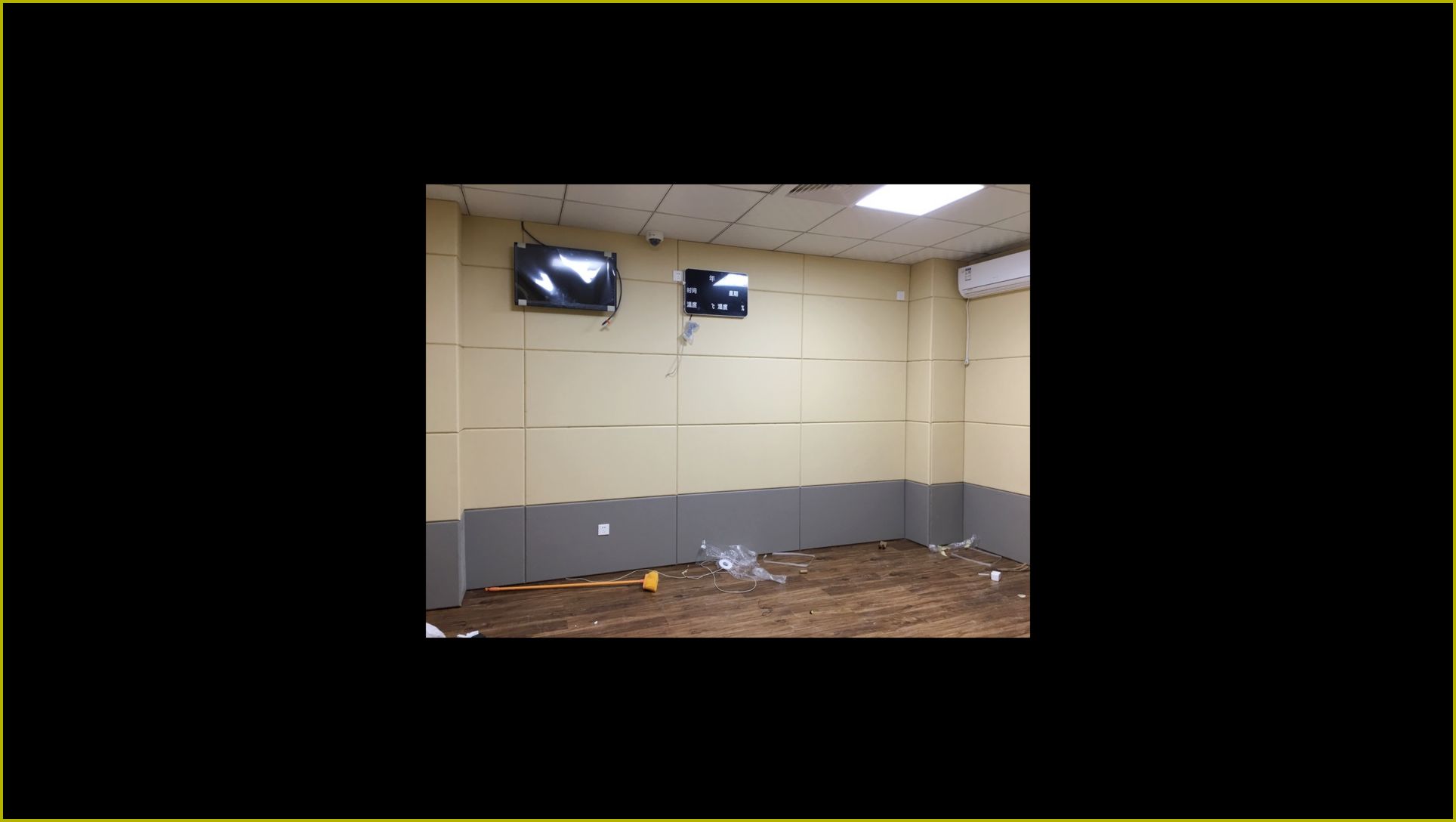
This piece exists because a property owner group chat keeps circulating a voice note about miracle foam. The claim: stick soundproofing foam on the ceiling and every noise problem dies. It does not. (I keep photos of failed foam jobs on my phone for exactly these conversations, and the gallery keeps growing.) What follows is the correction, section by section, with the numbers I use on site.
The foam sticker belief that will not die
The root error is treating two different jobs as one. An acoustic baffle is an absorber suspended in the open volume below the structure, hung with air on both faces so reverberant sound reaches two surfaces instead of one. Absorption drains the energy already bouncing inside the room. Insulation is a separate physics problem decided by mass, decoupling and airtight detailing, the territory of GB 55016-2021, which sets a minimum 50 dB airborne sound insulation for party walls between dwellings. No foam tile, no fabric panel, no baffle at any price moves a lightweight partition toward that 50 dB figure. Foam tames ring. It never blocks.
When buyers search for soundproofing baffles, most of them actually need reverberation control in a big empty room; when the complaint is a neighbor's TV or the compressor room next door, the baffle aisle is the wrong aisle entirely, and the budget belongs in the wall build-up, the door seal or the floor. This quarter I walked two clients off that cliff. Both times the real leak was a 12 mm gap under a corridor door. We spent $40 on seals. Problem gone.
Baffles belong in tall rooms with hard surfaces
Acoustic sound baffles earn their cost where ceiling height gives sound travel time and hard finishes give it nothing to grip: sports halls, natatoriums, production floors, open offices under bare concrete soffits. Height does the work. The panel intercepts mid and high frequency energy in the empty volume that wall panels struggle to reach, without occupying a single square meter of usable wall, which is why the large-room solution usually costs less for each unit of reverberation it removes. Ever since the egg-tray era, when people taped cartons to bedroom walls and called it treatment, this trade has fought the belief that small-room tricks scale up. They do not.
Two spots where baffles routinely disappoint
- Rooms below 30 m² with ceilings under 3 m, where a 24 mm panel has almost no volume to work in and standing waves below 250 Hz ignore it entirely
- Complaints about sound passing through a lightweight partition, which absorption cannot touch regardless of how many panels you hang
My honest position, since clients keep asking: for a home living room at 2.7 m ceiling height I never spec baffles, full stop. Rugs, heavy curtains and two wall panels do more per dollar, and they photograph better. Anyone selling a baffle grid for a bedroom is selling decoration.
Does doubling the baffle count double the absorption?
No, and the quotes that pretend otherwise are the ones I enjoy arguing with. Absorption scales with exposed area, edges included, but the room pays back diminishing returns as the reverberant field weakens: the first 30 percent of ceiling coverage does the heavy lifting, and every row after that buys less audible improvement per dollar spent. A district gymnasium in Chengdu taught me this the expensive way, when we pushed coverage from 45 to 60 percent chasing one complaints callout, the RT60 moved perhaps 0.1 s, and the invoice grew by a third. Nobody inside that hall could hear the difference. The owner heard the invoice.
For a hall between 8,000 and 15,000 m³, plan acoustic baffles at 30 to 40 percent of ceiling area, rows at 400 to 600 mm centers, with gaps roughly equal to panel width so the sound field sees an even absorbing surface. Then stop, retest per ISO 3382, and add rows only if the number still reads above target. Measure first. Buy second.
Material grades and the fire report that decides acceptance
Fire paperwork decides projects before acoustics gets a word in. Every baffle shipped into a public building should arrive with a burning behavior report per GB 8624-2012, issued by a CMA-qualified testing agency; Class A is what hospitals, airports and school projects demand, and B1 is the usual acceptance floor for gyms and offices. (On inspection day, ask the installer to bring the fire report matching the delivered batch, not the scan from three years ago, because inspectors do read dates.) Density and thickness then decide what the panel actually absorbs: a fabric-faced glass wool baffle at 50 mm and 48 kg/m³ reaches NRC 0.90 per ASTM C423, while the same core cut to 25 mm slides toward 0.70 and loses its grip exactly in the 250 to 500 Hz band where gym boom lives.
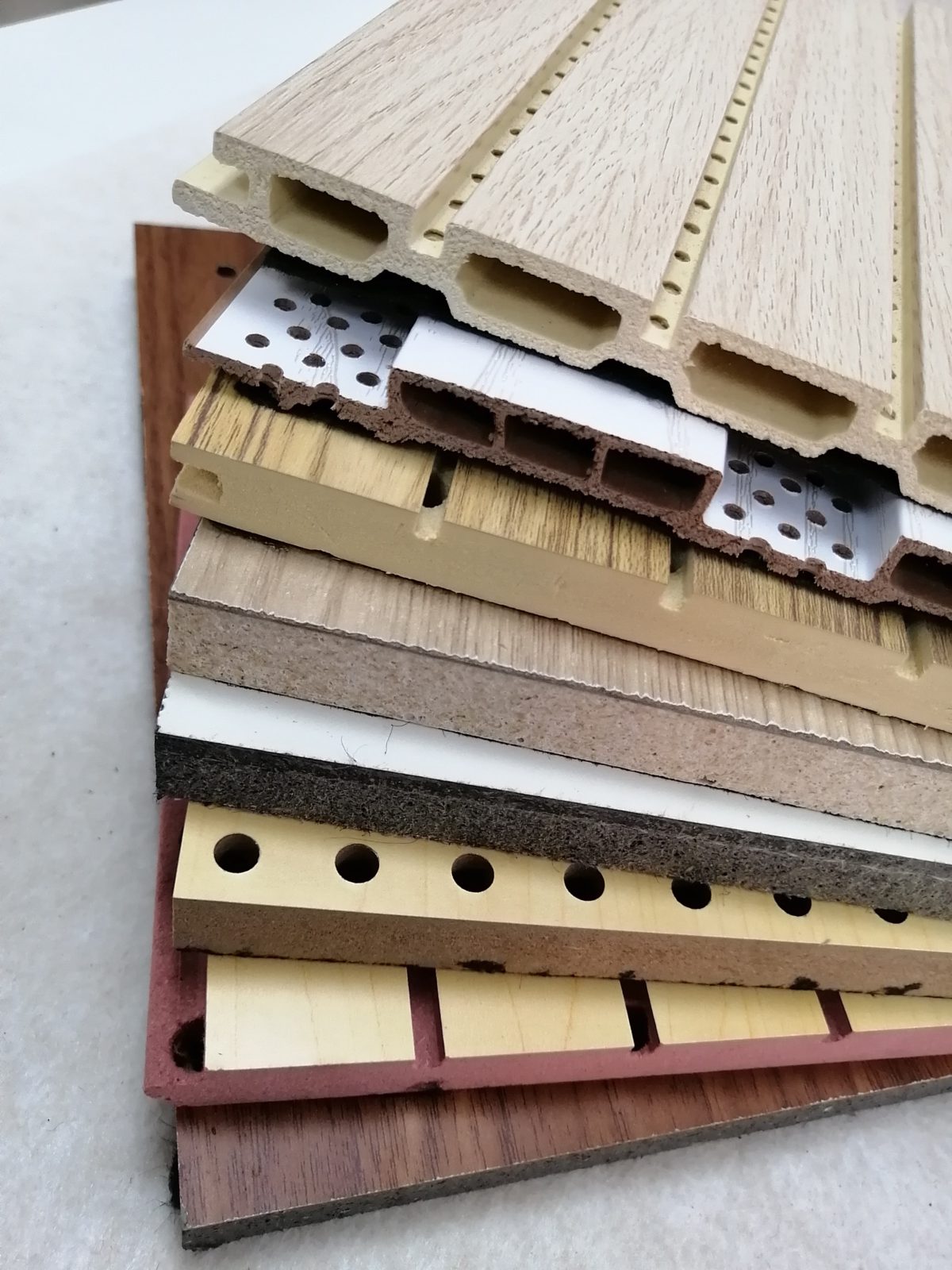
The comparison sheet I hand across the counter looks like this, with factory-direct price indications:
| Acoustic baffle material | Core spec | NRC, ASTM C423 | Fire class, GB 8624-2012 | Factory price | Where it fits |
|---|---|---|---|---|---|
| Fabric-faced glass wool | 50 mm, 48 kg/m³ | 0.90 to 0.95 | A | $14 to $22 per m² | Sports halls, factories, airports |
| PET polyester felt | 24 mm, 200 to 300 kg/m³ | 0.55 to 0.65 | B1 | $8 to $14 per m² | Offices, classrooms, budget retrofits |
| Melamine foam | 50 mm, 10 kg/m³ | 0.90 | A2 | $28 to $45 per m² | Hospitals, clean areas, transit halls |
| PVC-faced fiberglass | 50 mm, 40 kg/m³ | 0.85 to 0.90 | A | $20 to $30 per m² | Natatoriums, food plants, wash-down areas |
| Wood acoustic baffle, veneer box with rock wool infill | 100 mm deep | 0.70 to 0.85 | B1 | $35 to $65 per m² | Lobbies, auditoriums, boardrooms |
Read the table as a scenario map first, because the ranking depends on your room. Wet air and hose-down cleaning point to PVC-faced fiberglass; a lobby or boardroom that must photograph well points to wood acoustic baffles; a school on a strict budget gets PET felt with no regrets. Acoustic baffle material is a scenario decision before it is a datasheet decision, and anyone quoting one wonder product for every room has not asked you enough questions.
Half your absorption can vanish on the hanging detail
The cheapest way to ruin a good baffle is to flatten it. Pressed flush against the slab, the panel buries one of its two absorbing faces, so you paid for two faces and you are using one, and field measurements in that configuration fall well short of the datasheet every time. Keep every panel at least 300 mm clear of the structure, hang from threaded rods or wire fixed into structural steel, never into deck seams, and tie rows against sway within 1 m of any air outlet, because a baffle swinging in the supply draft both rattles and wears its anchors. If you judge bids by unit price alone, this is the trap you will step into: the low number quietly swaps suspension hardware for flush-fix channels, and the shortfall only shows up at the retest.
- Minimum 300 mm clear between baffle top and slab so the second face stays live
- Anchors into structural steel with a sway tie near every diffuser, checked before the scaffold comes down
Hardware never makes the brochure. It decides the retest.
What should a fair baffle quote look like?
Indicative factory-direct pricing runs $8 to $14 per m² for PET felt baffles, $14 to $22 for fabric-faced glass wool, $28 to $45 for melamine foam, and $35 to $65 for wood acoustic baffles depending on veneer grade and slot pattern. On top of material, budget 25 to 40 percent for installation, access equipment and freight on a standard hall job, and treat a bid far below that envelope as a place where corners are hiding.
Line items that move the invoice
Access drives labor harder than panel count does. A hall reachable with scissor lifts runs days cheaper than one requiring scaffold over bleachers, and night shifts worked around training hours add their own line. Ask for the coverage percentage and the predicted reverberation target in writing, hold 10 percent of payment against the ISO 3382 retest, and the incentives line up on your side of the table.
When clients ask where to order direct, I point them to 景丽伦英文站, a working factory that cuts and wraps its own panels: free measurement and layout design, factory-direct pricing without distributor markup, and material packs whose CMA fire report and GB/T 20247 absorption data pass acceptance on exactly the kind of projects described above. Their engineers will size a hall from a floor plan and a ceiling height before you commit a dollar.
The judgment standard before any deposit moves: a serious quote states panel thickness, core density, NRC with its test standard, fire class with report number, coverage percentage and row spacing. If those lines are missing, the number is theater. Send your floor plan, ceiling height and a phone photo of the space through the inquiry form on the 景丽伦英文站 site and you will have a free coverage layout with a firm factory quote within two working days.
How many acoustic baffles does a 500 m² gym need?
Plan baffles covering 30 to 40 percent of the ceiling, which means 150 to 200 m² of baffle area; at the common 1.2 m by 0.6 m panel that comes to roughly 210 to 280 pieces hung in rows. Retest reverberation after phase one, then add rows only if the reading still sits above 2.0 s.
Do acoustic baffles block noise from my neighbor?
No. Baffles absorb reverberation inside a room, they add almost no mass and no sealing to a partition, and mass with airtight detailing is what GB 55016-2021 insulation ratings measure. For neighbor noise, spend on the wall build-up, door seals and gaps, and skip ceiling baffles entirely.
Acoustic baffles or wall panels: which works better in a hall?
Above a 4 m ceiling, baffles usually win on cost per unit of absorption because both faces and all edges stay exposed to sound in the open volume. Wall panels take over when ceilings run low, ducts crowd the soffit, or two long parallel walls need direct treatment. Many halls end up with both.
How much do acoustic baffles cost per square meter?
Factory-direct indications: PET felt $8 to $14 per m², fabric-faced glass wool $14 to $22, melamine foam $28 to $45, wood acoustic baffles $35 to $65. Installation, access equipment and freight add 25 to 40 percent on a standard hall job.
How long does baffle installation take in a standard gym?
A 500 to 800 m² gym with scissor-lift access takes a three-person crew three to five working days, including layout, hanging, sway ties and cleanup. Add two to three days if new anchor points must go into the roof steel or the schedule works around evening training.

Leave A Comment