




Sound deadening panels are porous absorbers built to shorten reverberation inside a room, and they will not stop noise passing through a wall, a door slab or a site fence. Eleven of the thirty 'no effect' complaints that reached my desk this quarter failed on exactly that distinction, because each caller had bought absorption to solve a transmission problem.
I am writing this twenty minutes after walking out of a trade hall with raw steel deck overhead, where the PA from the far stage arrived as pure mush and my ears were still ringing at the exit. Spaces like that are where acoustic sound deadening panels earn every cent, and where skipping them costs the most per square meter.
Absorption and Blocking Are Two Different Jobs
A panel absorbs by letting sound enter its fibers, where friction between the moving air and the material turns acoustic energy into a trickle of heat. Blocking runs on a different mechanism, decided by mass, airtightness and decoupling, and a 12 mm polyester sheet glued to drywall shifts the partition's insulation rating by under 2 dB, often under 1. I have the complaint tickets to prove it.
A punch-press workshop in a northern province ordered 9 mm PU foam last autumn hoping to quiet an office block twenty meters from the line. The foam did its real job, the offices stayed exactly as loud, and the owner rang our after-sales line twice in one week. The noise had ridden the steel frame as structure-borne vibration, and no absorber on a wall could touch it.
Absorption earns its keep inside the room you treat: cafeterias, classrooms, open offices, gyms, dispatch halls, anywhere speech should arrive once instead of four times. Sound deadening sheets and sound deadening boards all do this one job, so pick them for echo and budget isolation separately.
Reading the Numbers Without Getting Fooled
NRC is the average absorption coefficient measured at 250, 500, 1,000 and 2,000 Hz under ASTM C423 in a reverberation room, and it is the most abused figure on any datasheet in this trade. Treat a claim of 0.95 NRC from a 9 mm sheet as a reason to leave the booth. Flat PET panels measure near 0.60 at 12 mm and near 0.75 at 25 mm on a hard wall.
Thickness buys low frequency. A 25 mm panel starts contributing around 500 Hz and does little below 250 Hz, which is why a drum room still booms after the walls look fully covered. Set the same panel 50 mm off the wall on standoff screws and the low-mid response climbs without buying anything thicker.
If you are choosing from photos, know that a 9 mm and a 14 mm sheet look identical on a screen, and the missing 5 mm is where speech-band absorption lives. Ask for surface weight in kg/m² plus the test report number, then bring a luggage scale on delivery day. Suppliers hate that check and buyers should run it every time.
Which Fire Grade Passes Inspection?
GB 55016-2021 makes reverberation limits mandatory for schools and offices in China, and ordinary classrooms must hold a 500 Hz to 1 kHz average at or below 0.6 s. A mandated target changes procurement too, because public interiors also clear combustibility grades under GB 8624-2012, where B1 is the practical floor for wall and ceiling finishes in assembly spaces. EU projects run the same logic through EN 13501-1.
This is where sound deadening foam panels lose contracts. Open-cell PU foam typically lands in Class E under EN 13501-1, and I once watched a fire officer fail an entire ceiling grid over one batch of it. Our PET line ships with a batch report from a CMA-accredited laboratory showing oxygen index at 32% or above, and that sheet of paper is the difference between signing acceptance on the first visit and re-cladding a hall at your own cost.
(At handover, make the contractor produce the fire test report and the absorption report for the delivered batch, with matching report numbers. Missing paperwork sends more projects back to square one than any panel defect I have handled.)
PET, Foam or Melamine?
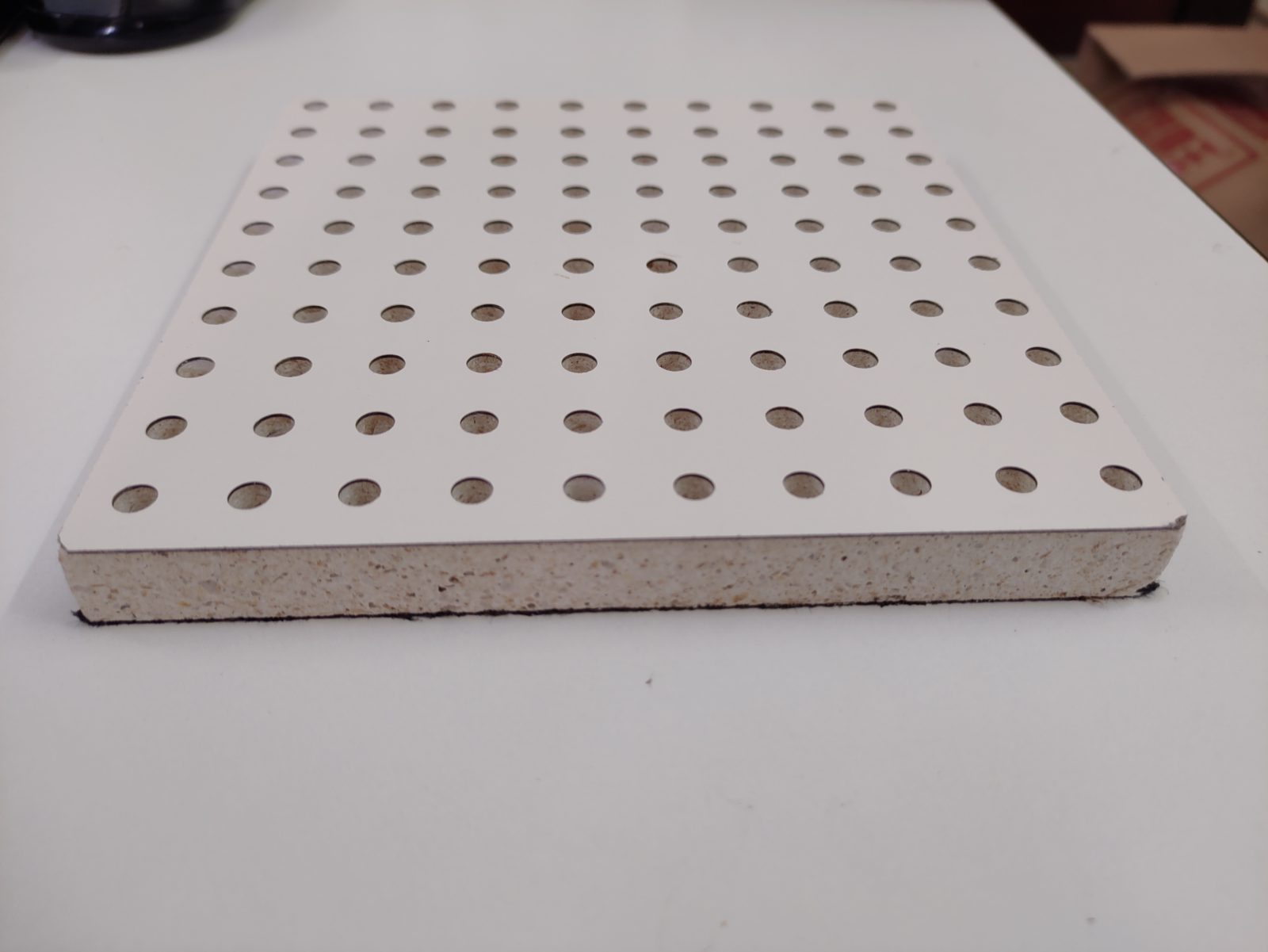
Melamine foam at 30 mm reaches about 0.70 NRC and holds Class B-s1,d0, so it owns ceilings in offices and schools where fire rules bite hardest. PET polyester is the workhorse: humidity stable, cuttable on site, printable, strong through the speech band. PU foam wins on price per square meter and fails at the fire test, which in public projects decides the whole order.
| Spec | PET polyester, 12 mm | Melamine foam, 30 mm | PU eggcrate, 25 mm |
|---|---|---|---|
| NRC (ASTM C423, hard mount) | 0.60 | 0.70 | 0.65 |
| Fire class (EN 13501-1) | C-s1,d0 typical | B-s1,d0 | E or unrated |
| Surface weight | 1.5 kg/m² | 0.35 kg/m² | 0.8 kg/m² |
| Humidity and contact | No swelling, wipeable | Dents under impact | Absorbs grease and oil |
| Typical FOB price | US$6–12/m² | US$18–30/m² | US$3–6/m² |
Table numbers move with mounting: the same PET panel can gain up to 0.15 NRC with a 50 mm cavity behind it, so a datasheet without a mounting note is half a datasheet. Outdoors the logic flips, because sound deadening fence panels along a shooting range or a substation boundary need galvanized skins, weatherproof absorptive infill and post spacing sized to wind load. Overhead, sound deadening ceiling panels do quiet work by intercepting speech before it ever reaches the furniture.
Honestly, for a home theater I would not push anyone toward Class B melamine at three or four times the price; a 25 mm PET layout on the first-reflection points does the job for a fraction of the spend. Public money and public rooms are where the fire premium pays for itself.
Where Installs Go Wrong
Coverage under 40% of the reflective surface rarely moves a measured RT60 at all; workable projects start near 50%, and speech-critical rooms want 60 to 70% concentrated on first-reflection zones. A few panels scattered around a hall at picture height is decoration with no measurable effect.
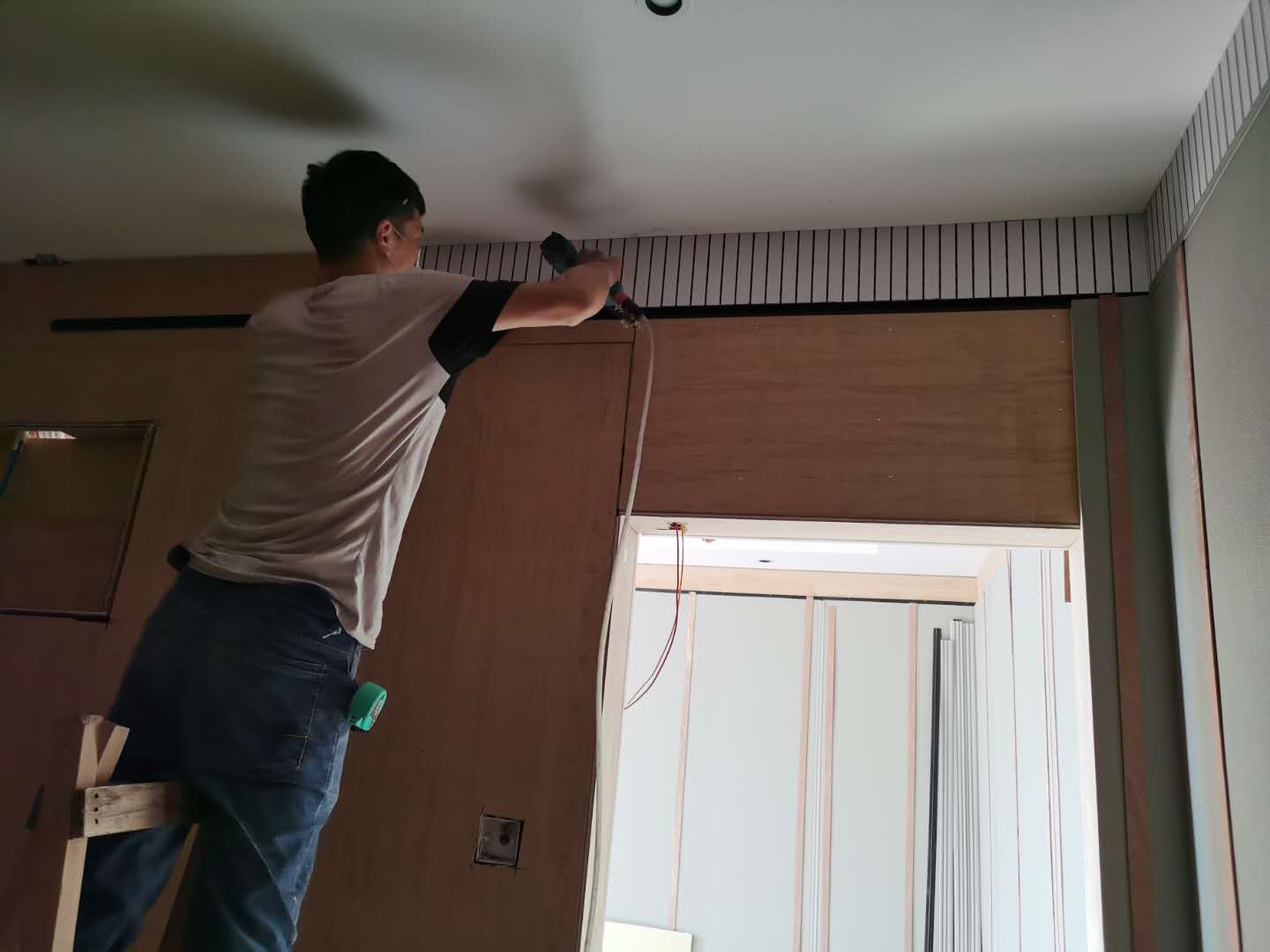
A KTV refit in a second-tier city last spring is my favorite caution ticket: 300 m² of 9 mm foam bonded with contact adhesive onto latex paint that had cured for only three days. Whole sheets started dropping onto the booths within eight months. Paint, dust and adhesive chemistry end more installations than panel quality does, and primer or a keel grid is cheap insurance against a callback.
Fixing method changes the numbers as much as thickness does. A keel grid holding panels 50 mm off the slab adds low-mid absorption, turns later maintenance into a ten-minute panel swap and hides cabling behind the plane. Direct glue saves a little on day one, then locks the result to the condition of the slab, and high-traffic corridors still need corner trims because bare panel edges do not survive kick tests.
What a Straight Quote Looks Like
Container-volume pricing for 12 mm PET runs about US$6 to 12 per square meter FOB, the 25 mm grade sits near US$10 to 18, melamine foam lands around US$18 to 30, and any PET quote under US$4 usually means thinner sheet or heavily recycled fiber with weak binding. Make the quote separate panel cost, fixing system and layout design, because a vendor who buries all three in one number is hiding the weakest of them.
This is where I point buyers at 景丽伦英文站, not because the logo impresses anyone but because the process survives audits: free on-site measurement and layout design by the engineering team, factory-direct pricing with no distributor layer, and every batch traceable to GB 8624-2012 test reports. Their 25 mm high-density PET went into a municipal police command center in East China last year; mid-frequency reverberation fell from 1.4 s to 0.6 s and the project passed acceptance on the first visit.
A 500 m² order runs 7 to 12 working days in production and 25 to 35 days on the water to Europe or the US west coast, so plan six to seven weeks door to door. Before any deposit changes hands, ask for two documents:
- Fire test report for the exact grade, EN 13501-1 or GB 8624-2012, with a report number you can verify.
- Absorption test to ASTM C423 or ISO 354 stating thickness and mounting condition, not a bare NRC figure.
One Number Settles It
Settle the argument with a reverberation measurement taken before the panels arrive and again one week after installation. Any phone app with an RT60 mode is accurate enough for an acceptance discussion, and a meeting room or classroom should land at or below 0.8 s in the mid frequencies. Starting at 1.4 s and finishing at 0.7 s means the panels did their job, sign the sheet.
If the meter barely moves, or speech stays muddy while the number improves, the fault sits in isolation or in the HVAC path, and no quantity of extra panels will repair either. Add coverage to the first-reflection zones before arguing about brands, because placement beats logo every time.
Send your room dimensions, two or three photos and the noise complaint in the client's own words to the engineering desk at 景丽伦英文站; the measurement, layout and factory-direct quote come back free with the test reports attached, which is the fastest route I know to keeping your project off my complaint list.
How much do sound deadening wall panels cost per square meter?
12 mm PET polyester lands around US$6 to 12/m² FOB at container volume, 25 mm runs US$10 to 18, and melamine foam sits near US$18 to 30/m². PU foam looks cheapest per sheet and turns out most expensive at the fire inspection.
Will sound deadening foam panels block noise reaching my neighbor through the wall?
No. Foam and PET absorbers cut echo inside the room and add under 2 dB to a partition's rating. Noise through walls needs mass loaded vinyl, decoupled studs and airtight perimeter seals, budgeted as a separate line.
What fire rating do sound deadening ceiling panels need in a public space?
Specify EN 13501-1 Class B-s1,d0, or GB 8624-2012 B1 on Chinese projects, because inspectors hold ceilings to stricter grades than walls. Demand the test report for the delivered batch, never a catalog page.
How long does a 500 m² panel order take from purchase order to port?
Production takes 7 to 12 working days, sea freight adds 25 to 35 days to Europe or the US west coast, and door to door you should plan six to seven weeks. Collect the test reports before paying any deposit.
How do I prove sound deadening panels worked at acceptance?
Measure RT60 before installation and one week after with any RT60 phone app. A meeting room should finish at or below 0.8 s mid-frequency; a drop from 1.4 s to 0.7 s is a clear pass.

Leave A Comment